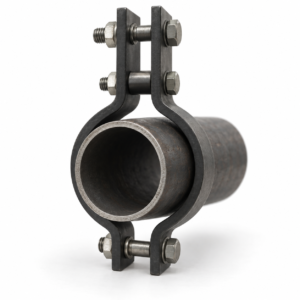
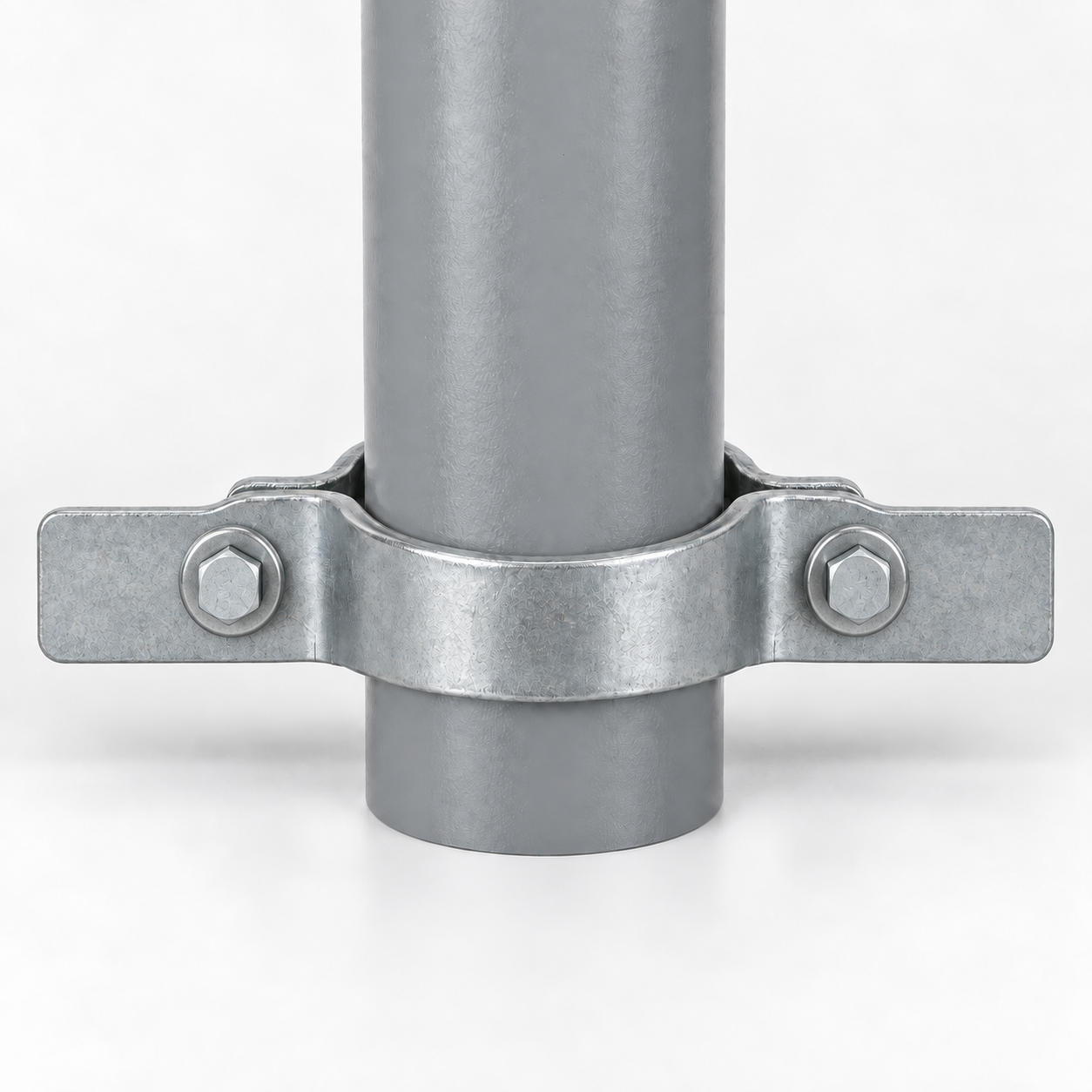
A two-bolt riser clamp is a split flat-steel pipe attachment used to support a vertical pipe at a floor opening, structural ledge, or another engineered bearing point. Two formed halves surround the pipe, side bolts join the assembly, and extended ears transfer the vertical reaction to the supporting structure. YOUNGLEE supplies custom carbon-steel and stainless-steel riser clamps for building services, fire-protection piping, industrial utilities, mechanical rooms, and fabricated support systems. Pipe size, actual outside diameter, strip section, ear length, bolt specification, material, finish, load path, coupling or shear-lug interface, and inspection documents are manufactured to an approved drawing or applicable project standard. Final load rating and installation suitability require project-specific engineering review.
Two-Bolt Riser Clamp at a Glance
| Product fact | Available or typical project basis | Important qualification |
|---|---|---|
| Product type | Two-piece flat-steel riser clamp for vertical pipe support | Commonly associated with MSS SP-58 Type 8 terminology when that standard and edition are specified |
| Main components | Two formed clamp halves, two side bolts, nuts, washers, and extended bearing ears | Coupling, shear lugs, floor sleeves, structural steel, and other load-transfer parts are separate unless stated on the approved drawing |
| Common materials | Fabricated carbon steel; stainless-steel options for qualified projects | Material grade, product form, heat treatment, welding, and traceability must be defined |
| Finish options | Plain, zinc plated, hot-dip galvanized, painted, or project-specified coating | Finish selection depends on environment, temperature, fabrication sequence, thread fit, and inspection requirements |
| Primary function | Transfer of vertical pipe reaction through a defined clamp and structural bearing arrangement | The clamp is not automatically an anchor, guide, seismic brace, or friction-only support |
| Pipe condition | Bare or coated vertical pipe; other interfaces by approved design | Insulated pipe needs a load-bearing support detail that does not crush insulation or damage a vapor barrier |
| Size basis | NPS or DN together with actual pipe outside diameter and tolerance | Nominal pipe size and actual outside diameter are not interchangeable |
| Customization | Inside profile, strip width and thickness, ear geometry, bolts, material, finish, and documentation | No universal stock range, load rating, or temperature limit is claimed |
Customization Note: YOUNGLEE finalizes the riser clamp only after reviewing the pipe data, support location, coupling or shear-lug arrangement, design load cases, bearing structure, material, finish, environment, drawing, standard edition, and inspection requirements.
How Does a Riser Clamp Support Vertical Pipe?
The two clamp halves close around the pipe and are tightened with side bolts. Their long ears project beyond the pipe so the assembly can bear on an approved floor or structural support. Vertical pipe load must then enter the clamp through a defined feature, commonly an approved coupling, shear lug, or another engineered attachment. The ears transfer that reaction into the supporting structure.
This load path must be explicit. Bolt tightening and surface friction alone should not be assumed to carry a vertical riser unless the complete assembly has been designed, tested, and approved for that mechanism. Pipe-wall stress, local reinforcement, lug welding, coupling geometry, bearing length, and the supporting opening all require review by the piping and structural designers.
What Does MSS SP-58 Type 8 Mean?
ANSI/MSS SP-58-2025 establishes an industry basis for pipe-hanger and support materials, allowable stresses, product design, testing, load ratings, selection, application, inspection, installation, and documentation. Standard riser clamps are commonly identified in industry catalogs as Type 8. The type number identifies a general support family; it does not prove that every look-alike custom clamp complies with a specified edition.
When MSS SP-58 is required, the RFQ should state the edition, type, pipe and support data, design load cases, material, finish, inspection, marking, and documentation. YOUNGLEE confirms compliance only after technical review. Supplier-specific dimensions, ratings, listings, and approvals remain tied to those suppliers’ exact products and must not be transferred to a custom assembly.
Which Dimensions and Interfaces Define the Clamp?
A useful riser-clamp drawing defines the pipe, clamp halves, side bolts, ears, load-transfer feature, bearing structure, and installation envelope as one system. NPS or DN alone is insufficient because actual outside diameter varies by pipe specification and because coating, tolerance, and interface details affect fit.
| RFQ input | Why it affects selection | What to provide |
|---|---|---|
| Pipe data | Controls the inside profile and local pipe assessment | NPS or DN, actual outside diameter, wall schedule or thickness, material, seam condition, coating, contents, and operating mass |
| Clamp body | Forms the primary pipe attachment | Strip width and thickness, inside diameter, half geometry, edge radius, gap, tolerances, and forming requirements |
| Bearing ears | Transfer reaction to the floor or support steel | Overall length, projection each side, bearing length, end shape, clearances, and supported edge condition |
| Side hardware | Joins the two halves and maintains the approved assembly | Bolt diameter, grade, thread standard, nuts, washers, hole or slot geometry, torque basis, locking method, and finish |
| Load-transfer feature | Introduces vertical pipe load into the clamp | Coupling, shear lugs, welded attachments, or another approved feature with location and design responsibility |
| Supporting structure | Receives ear-bearing reactions and defines installation access | Floor or steel opening, edge distances, bearing surface, sleeve, firestop, corrosion interface, and allowable reaction |
| Service conditions | Affect material, coating, expansion, and inspection | Operating and test loads, temperature, corrosion exposure, movement, vibration, fire or seismic requirements, and maintenance access |
| Quality documents | Define acceptance and traceability | Approved drawing, material certificates, dimensional report, coating records, weld records where applicable, inspection, and packing marks |
Customization Note: Dimensions and load values in independent catalogs belong to their named product series. YOUNGLEE uses the buyer’s approved drawing or the explicitly named standard and edition; third-party tables are not presented as universal manufacturing data.
Pipe Coupling, Shear Lug, and Friction Are Different Load Paths
A coupling or enlarged fitting positioned above the clamp can provide a geometric stop when the complete arrangement is approved for that duty. Welded shear lugs can transfer load directly from the pipe into the clamp, but lug material, weld procedure, pipe-wall stress, inspection, temperature, and corrosion must be engineered together. Some specialized clamps may use controlled clamping force and friction, but that mechanism cannot be inferred from appearance or bolt torque alone.
The RFQ should identify which party designs the pipe attachment, who verifies the supporting structure, and which loads the clamp must carry. If the drawing omits the load-transfer feature, YOUNGLEE will request clarification rather than assume a safe mechanism.
Material and Finish Selection
Carbon steel is a common fabrication material for standard riser clamps because flat strip, formed halves, bolts, and compatible finishes are readily specified. Stainless steel may be selected for washdown, coastal, chemical, or material-compatibility requirements. The exact grade and condition must be stated; “stainless steel” alone is incomplete. For another corrosion-resistant clamp construction, see YOUNGLEE’s 316 stainless-steel pipe clamps.
Plain steel, electroplated zinc, hot-dip galvanizing, paint, and project coatings are not interchangeable. Forming and welding sequence affect coating coverage; coating thickness affects holes and threads; and galvanizing requires allowance for drainage, distortion, and repair. Specify the coating standard, class or thickness, surface preparation, color where controlled, masking, repair criteria, compatible fastener finish, and required test records.
Riser Clamp Compared with Other Pipe Supports
| Support arrangement | Primary function | Selection caution |
|---|---|---|
| Two-bolt riser clamp | Supports a vertical pipe at a structural bearing level through a defined pipe-to-clamp load path | Coupling, lug, bearing structure, pipe wall, bolts, and clamp must be checked as one system |
| Heavy-duty lugged riser clamp | Transfers larger or project-specific reactions through engineered pipe lugs and clamp geometry | Do not substitute a standard Type 8-style clamp for a lugged special design without engineering approval |
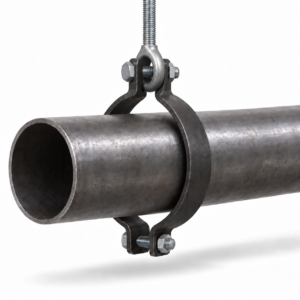
| Adjustable clevis hanger | Suspends stationary horizontal pipe from a hanger rod | Its yoke, lower cradle, cross bolt, and overhead load path differ; compare the adjustable clevis pipe hanger |
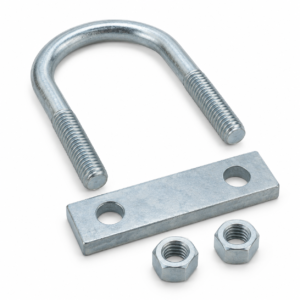
| U-bolt pipe clamp | Fastens or restrains pipe against a plate, channel, or fabricated support | It does not provide the same floor-bearing ears or vertical-riser load path |
| Pipe shoe or base support | Transfers load from a horizontal or vertical pipe through a shoe, stanchion, or base | Attachment, thermal movement, local pipe stress, and structural reactions require separate design |
Customization Note: Support selection depends on piping orientation, stress analysis, load combinations, movement, temperature, insulation, structural interface, accessibility, and inspection. This table compares functions and is not a substitution schedule.
How Should Insulated or Coated Pipe Be Handled?
A standard riser clamp fitted directly to bare steel pipe should not automatically be applied over soft insulation. The load path can crush insulation, damage a vapor barrier, or create uncontrolled movement. Insulated vertical piping may require a load-bearing insulation insert, engineered support ring, pipe lugs extending through the insulation system, an external support sleeve, or another project-specific detail.
Coated pipe also needs controlled edges, fit, assembly clearance, and compatible contact surfaces. The project should define whether the clamp is installed before or after the pipe coating, which surfaces are masked, how damaged coating is repaired, and whether dissimilar-metal isolation is required.
Load, Temperature, and Movement Require Project Review
Published catalog ratings apply only to the stated supplier series, size, material, strip section, hardware, finish, test basis, safety basis, and installation condition. They cannot be copied to a custom YOUNGLEE clamp because the silhouette is similar. Provide sustained, operating, occasional, test, and applicable dynamic loads, together with temperature, corrosion, movement, and structural reactions.
Vertical thermal growth can shift load among support levels or introduce forces not visible in a simple static sketch. The piping analysis should identify which riser levels carry weight, which allow movement, and whether guides, anchors, springs, expansion joints, or other devices are required. A riser clamp is not automatically a seismic brace or anchor.
Installation and Inspection Considerations
Before installation, verify the approved drawing, pipe outside diameter, clamp material and finish, bolt specification, ear orientation, coupling or lug detail, and bearing structure. Inspect formed halves for cracks, sharp edges, distortion, damaged holes, coating defects, and shipping deformation. Confirm that the opening and surrounding structure can receive the ear reactions without interference.
Assemble the two halves in the specified orientation, install all washers and locking features, and tighten hardware using the approved procedure. Both ears should bear as intended; site bending, packing with unapproved loose pieces, or forcing an undersized clamp around the pipe can invalidate the design. Final inspection should record fit, bolt engagement, bearing, load-transfer feature, coating condition, clearance, firestop or sleeve interface, and any required torque or dimensional results.
The featured image is a generated representative visual of an unbranded two-bolt riser clamp on a short vertical pipe. It shows the general split clamp, side bolts, and bearing-ear geometry only. It does not prove a material grade, coating standard, dimensions, load rating, temperature limit, certification, listing, or previous YOUNGLEE project supply.
Frequently Asked Questions
Is a riser clamp the same as a U-bolt?
No. A standard riser clamp uses two formed flat-steel halves with extended bearing ears around a vertical pipe. A U-bolt is a bent rod with two threaded legs and normally fastens pipe to another member. Their geometry and load paths are different.
Can a riser clamp support pipe by friction alone?
Do not assume so. A standard installation commonly uses a coupling, shear lug, or another approved pipe attachment to introduce vertical load into the clamp. Friction-only support requires a specifically engineered and validated assembly.
Can the clamp be selected from NPS or DN alone?
No. Provide NPS or DN plus actual pipe outside diameter, wall data, coating, manufacturing tolerance, and the required fit. The drawing must also define the bearing ears, bolts, support opening, and load-transfer feature.
Does Type 8 automatically mean MSS SP-58 compliant?
No. Type 8 identifies a general product family. Compliance also depends on the specified edition, material, design, testing, load rating, manufacture, marking, documentation, selection, and installation requirements.
What documents can be supplied?
Depending on the purchase specification, documentation may include approved manufacturing drawings, material certificates, dimensional reports, coating records, fastener certificates, welding records where applicable, inspection results, packing lists, and traceability records. Required documents and acceptance criteria must be agreed before manufacture.
Request a Quote for Two-Bolt Riser Clamps
Send YOUNGLEE the NPS or DN and actual pipe outside diameter, pipe material and wall thickness, coating or insulation system, strip width and thickness, clamp inside profile, overall ear length and bearing detail, bolt diameter and thread, hardware grade, coupling or shear-lug arrangement, support opening, material grade, finish, quantity, operating and test loads, temperature, corrosion environment, movement and vibration requirements, inspection documents, drawing, and applicable standard with edition. For every inch dimension, preserve every decimal place supplied by the buyer: YOUNGLEE multiplies the unrounded inch value by 25.4 to convert it to millimetres. Custom riser clamps are confirmed only after project technical review and approval of the manufacturing drawing.