A U-bolt hanger rod stiffener kit is a pipe-support hardware assembly that uses one formed U-bolt, a two-hole plate, and matching nuts to connect stiffener channel around a vertical threaded suspension rod. YOUNGLEE supplies custom kits for industrial piping, mechanical, electrical, and plumbing support frames where the project design requires a rod-stiffening connection. U-bolt inside width, rod diameter, plate geometry, thread, material, finish, and compatible strut can be produced to an approved drawing. The kit is not a complete seismic restraint system and does not establish rod compression capacity by itself; the supporting structure, hanger rod, stiffener spacing, loads, installation torque, and governing approval must be confirmed by the project engineer.
U-Bolt Hanger Rod Stiffener Kit at a Glance
| Product fact | Available project basis | Information for Buyer Confirmation |
|---|---|---|
| Product type | Formed U-bolt, two-hole bearing plate, and two matching nuts for a hanger-rod stiffening connection | Approved assembly drawing, connection orientation, and complete bill of materials |
| Primary function | Attach stiffener channel to a threaded hanger rod in an engineered support or bracing layout | Compression demand, lateral restraint direction, spacing, end conditions, and governing design criteria |
| Typical kit content | One U-bolt, one two-hole plate, and two nuts; optional washers only when the drawing requires them | Nut style, washer requirement, spare hardware, packaging, and identification |
| Common materials | Carbon steel; stainless-steel options where the grade, strength, and environment are compatible | Material standards, grade, mechanical properties, forming condition, and traceability |
| Finish options | Electro-zinc, hot-dip galvanized, plain, or project coating; stainless steel may be supplied uncoated | Coating standard, thickness or class, passivation, thread allowance, repair, and mating finishes |
| Size basis | Made around actual hanger-rod and stiffener-channel dimensions rather than a generic nominal description | Rod major diameter and thread, channel profile, wall thickness, coatings, and installation clearance |
| Customization | U-bolt diameter, inside width, bend radius, leg and thread length, plate size, hole spacing, and finish | Drawing revision, tolerances, loads, acceptance method, documentation, and quantity |
Customization Note: These are configurable supply options, not a universal size series, seismic approval, or load rating. Every component and installation parameter must be coordinated with the approved hanger-rod stiffening design.
What Does a Hanger Rod Stiffener Kit Do?
A long threaded hanger rod can be slender. In support arrangements where the rod may see project-defined compression, a separate channel or other stiffening member may be placed alongside the rod to reduce its unbraced length. The U-bolt hanger rod stiffener kit provides one mechanical tie point between the rod and that stiffening member. Multiple connections may be required along the rod, but their number and spacing come from the engineered system rather than from the kit alone.
Buyers may use the terms hanger rod stiffener with U-bolt, threaded rod stiffener kit, strut rod stiffener hardware, or rod-to-channel stiffener clamp. These terms describe the same broad procurement intent, but not necessarily identical hardware. Some proprietary products use clips, break-off bolts, or internal channel fasteners instead of a U-bolt and plate.
Why the U-bolt and plate are both important
The U-bolt wraps the drawing-defined member or interface, while the plate bridges the two threaded legs and provides bearing under the nuts. This creates a compact clamping connection without welding the threaded rod. U-bolt bending, plate bending, hole bearing, thread loading, nut seating, coating friction, channel deformation, and installation access can all influence behavior. An apparently similar catalog kit is therefore not proof of equivalent capacity.
What the kit does not include
Unless the quotation says otherwise, the kit does not include the threaded hanger rod, stiffener strut, upper building attachment, transverse or longitudinal brace, pipe hanger, pipe clamp, anchors, or engineering calculations. It must not be presented as a complete seismic brace, a certified restraint, or a substitute for project design.
How Is It Different from Other U-Bolt Products?
| Assembly | Members connected | Main selection inputs | Important distinction |
|---|---|---|---|
| U-bolt hanger rod stiffener kit | Threaded hanger rod and adjacent stiffener channel | Rod size, channel profile, U-bolt geometry, plate, spacing, finish, design criteria | Stiffens a suspension rod within an engineered support layout |
| Standard pipe U-bolt | Pipe to beam, channel, or support surface | Pipe actual OD, grip or guide function, rod diameter, leg length, thread | Contacts the process or service pipe rather than the hanger rod |
| Strut beam clamp with U-bolt | Strut channel to a structural beam flange | Flange thickness, channel profile, pair spacing, loads, edge engagement | Forms an upper structural attachment rather than a rod-stiffener tie |
| Rod stiffener clip or bolted channel clamp | Threaded rod to stiffener channel | Rod range, channel gauge, fastener torque, approvals, spacing | May perform a related function with proprietary non-U-bolt geometry |
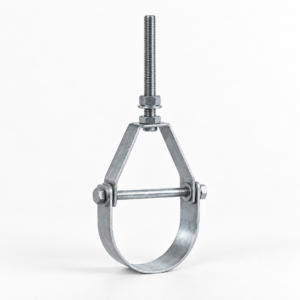
| Clevis hanger | Horizontal pipe to a vertical suspension rod | Pipe OD, load, hanger size, insulation, rod connection, adjustment | Supports the pipe; it does not stiffen the rod against compression |
Customization Note: This comparison explains product identity and procurement inputs only. It does not establish interchangeability, approval equivalence, or permission to replace a proprietary listed component.
Dimensions Needed for a Custom Rod Stiffener Kit
The buyer should provide one assembly drawing showing the threaded rod, stiffener channel, U-bolt, plate, nuts, nearby hanger hardware, and required connection locations. Nominal strut or rod descriptions alone may omit wall thickness, lip geometry, coatings, thread form, or tolerance that changes fit.
| Dimension or input | Why it matters | Information for Buyer Confirmation |
|---|---|---|
| Hanger-rod diameter and thread | Controls the rod interface, installation clearance, and compatible system detail | Major diameter, thread series, pitch or TPI, tolerance class, material, coating, and straightness |
| Stiffener-channel profile | Controls the U-bolt inside width, bend, plate position, and contact surfaces | Overall width and depth, wall thickness or gauge, lip shape, slots, finish, and orientation |
| U-bolt rod diameter | Affects forming strain, strength, plate-hole fit, nut size, and required bend radius | Nominal and actual diameter, material, mechanical properties, forming process, and tolerance |
| U-bolt inside width and bend | Determines contact and clearance around the drawing-defined member | Inside width, inside height, bend radius, tangent points, leg parallelism, and datum |
| Leg and thread length | Must accommodate the plate, nuts, optional washers, coating, runout, and tool access | Overall leg length, usable thread, runout, minimum engagement, and maximum protrusion |
| Plate dimensions | Influence bending, bearing, nut seating, clearance, and mass | Length, width, thickness, corner treatment, flatness, material, and finish |
| Plate-hole pattern | Must match the finished U-bolt without forcing the legs or seating nuts on hole edges | Hole diameter, center spacing, edge distance, tolerance, and whether slots are permitted |
| Connection locations | Determine the rod’s effective unbraced segments in the complete design | Quantity per rod, vertical spacing, distance from ends, brace direction, and installation sequence |
Customization Note: Coordinate all dimensions on one approved drawing. If inch dimensions are supplied, preserve every stated decimal place before multiplying by 25.4; do not round the inch value before conversion. Fractions and thread designations should remain traceable to the source drawing.
Published Industry Reference Example
Eaton’s B-Line strut catalog identifies an SC-UB hanger rod stiffener as a kit containing a B3188-1-1/2 WO U-bolt, two 3/8-16 hex nuts, and one two-hole plate for 3/4 in through 7/8 in all-threaded rod. The catalog also shows a 1/4 in × 1-5/8 in × 3-1/2 in plate and lists zinc as the standard finish. These values confirm the commercial product identity, but they remain Eaton-specific catalog data. They are not YOUNGLEE standard dimensions, ratings, certifications, approvals, or evidence of prior supply.
| Eaton published reference item | Exact source value | Exact metric conversion | Information for Buyer Confirmation |
|---|---|---|---|
| All-threaded rod range | 3/4 in through 7/8 in | 19.05 mm through 22.225 mm | Actual rod major diameter, thread, tolerance, material, coating, and design compression demand |
| Included U-bolt identity | B3188-1-1/2 WO | 1-1/2 in designation retained; 38.1 mm arithmetic conversion | Required inside width, rod diameter, bend radius, leg length, thread, and compatibility |
| Included nuts | Two 3/8-16 hex nuts | 3/8 in nominal equals 9.525 mm; 16 threads per inch retained | Thread system, nut standard, grade, proof requirement, finish, lubrication, and locking method |
| Two-hole plate | 1/4 in × 1-5/8 in × 3-1/2 in | 6.35 mm × 41.275 mm × 88.9 mm | Plate thickness, width, length, hole spacing, hole diameter, grade, flatness, and finish |
| Standard finish | Zinc | No conversion applies | Electro-zinc or another specified process, coating standard, thickness/class, passivation, and inspection |
Customization Note: The table preserves the published inch values and converts them without rounding. It is a qualified industry reference only. A YOUNGLEE quotation must use the buyer’s approved geometry, loads, material, coating, and acceptance requirements.
Material and Finish Selection
Carbon-steel U-bolt and plate
Carbon steel is a common basis for indoor and protected industrial support hardware. Specify the U-bolt material and mechanical properties separately from the plate material because forming, threading, and bearing requirements differ. A generic description such as “mild steel” is not enough when the assembly forms part of an engineered bracing system.
Electro-zinc coating
ISO 4042:2022, with Amendment 1:2026, addresses electroplated coating systems for steel fasteners, including zinc and zinc-alloy systems and measures related to hydrogen-embrittlement risk. ASTM B633-23 covers electrodeposited zinc coatings on iron and steel articles but encourages purchasers to consider a fastener-specific standard for mechanical fasteners. The purchase specification should identify which standard governs the U-bolt, nuts, and plate; required coating class or thickness; passivation and sealer; thread fit; lubrication; and documentation.
Hot-dip galvanized options
Hot-dip galvanizing may be considered for outdoor service, but it is not interchangeable with electro-zinc. Coating thickness can change plate-hole clearance, thread fit, nut tapping, and assembly geometry. Confirm whether components are galvanized after forming, the applicable hardware and fabricated-item coating standards, oversize or retapped nuts, repair method, surface appearance, and compatibility with the adjacent strut and rod.
Stainless-steel options
304, 304L, 316, or 316L stainless steel may be supplied when technically suitable. Grade alone does not establish seismic capacity, chloride resistance, or approval. The engineer should review strength condition, forming, galling, nut pairing, lubrication, surface finish, crevice exposure, and dissimilar-metal contact with galvanized strut or carbon-steel rods.
Standards and Project Qualification
ANSI/MSS SP-58-2025 provides an industry basis for the materials, design, manufacture, selection, application, inspection, and installation of pipe hangers and supports and their components. Referencing SP-58 does not automatically assign a load rating or seismic approval to a custom rod stiffener kit. The project specification must identify the applicable building code, seismic design criteria, component importance, brace layout, calculations, testing, inspection, and approval pathway.
Public manufacturer catalogs show both U-bolt-and-plate kits and alternative rod stiffener clips. Those sources establish an independent procurement need, not a universal geometry. If a project names a proprietary listed product or requires an agency approval, substitution is outside this product page and must be reviewed by the engineer and authority having jurisdiction.
Engineering and Installation Review
Define the load path before ordering
The rod stiffener kit is only one interface in a chain that includes the supported pipe or equipment, hanger, threaded rod, stiffener channel, brace, upper attachment, anchors, and building structure. Compression, tension reversal, eccentricity, channel bending, local crushing, fastener slip, vibration, and installation tolerances may govern different parts of that chain.
Control spacing and end conditions
Rod-stiffener connection spacing influences the effective unbraced length of the threaded rod. Do not copy spacing from a visually similar catalog detail. The engineer should state the number of kits per rod, maximum spacing, first and last connection locations, stiffener termination, orientation, and any required inspection access.
Use a specified tightening method
Nut torque depends on thread system, material, coating, lubrication, nut grade, plate bearing, and required clamp behavior. Excessive tightening may distort the strut, plate, or U-bolt; insufficient tightening may allow movement. The approved procedure should define torque or another tightening method, inspection marks, recheck requirements, and whether washers are permitted.
Verify field compatibility
Before installation, confirm that the U-bolt passes cleanly through both plate holes without forcing the legs, the plate seats fully, the nuts engage the required thread length, and tools can reach both nuts. Check nearby couplers, hangers, braces, slots, welds, and building attachments. Do not field-bend, flame-adjust, grind, or enlarge holes unless an approved procedure permits it.
Typical Applications
- Threaded-rod suspension systems for industrial piping and mechanical services;
- MEP trapeze supports where the engineered layout requires vertical rod stiffening;
- Fire-protection, HVAC, process-piping, conduit, or equipment supports when the project design specifically includes the kit;
- Retrofit support frames where welding to the hanger rod is not permitted;
- Custom strut-and-rod bracing details manufactured to an approved drawing.
For an upper channel-to-beam attachment, review the strut beam clamp with U-bolt. For direct support of horizontal pipe from a hanger rod, compare an adjustable clevis pipe hanger. For direct pipe-to-support clamping, see the zinc-plated carbon-steel U-bolt pipe clamp. These products occupy different locations in the support load path and are not interchangeable.
Representative Image Disclosure
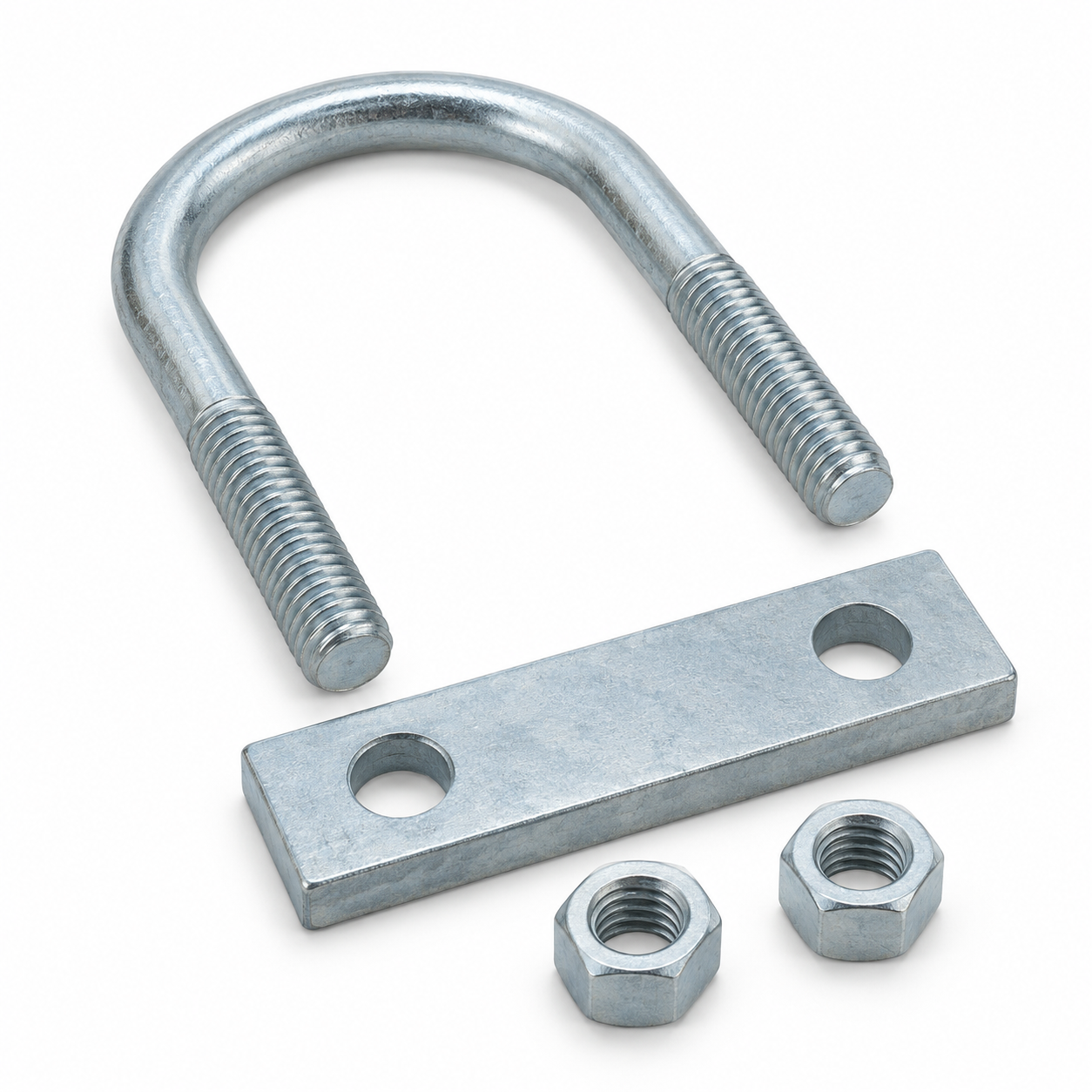
The featured image is a newly generated representative flat-lay visual of an unassembled kit. It shows exactly one zinc-plated-style round-bend U-bolt, one rectangular two-hole plate, and two hex nuts on a white background. The image does not establish dimensions, material or fastener grade, coating process or thickness, thread specification, load rating, seismic approval, certification, previous project supply, or suitability for any installation. The approved drawing and purchase specification control the delivered assembly.
What Should the Buyer Provide for Quotation?
- Complete support and bracing drawing showing the threaded rod, stiffener channel, kit locations, orientation, and adjacent components;
- Hanger-rod diameter, thread series, pitch or TPI, material, coating, straightness, and mechanical properties;
- Stiffener-channel profile, dimensions, wall thickness or gauge, slot pattern, material, finish, and orientation;
- U-bolt rod diameter, inside width, bend radius, leg length, thread length, thread specification, and tolerances;
- Two-hole plate length, width, thickness, hole diameter, center spacing, edge distance, material, finish, and flatness;
- Nut standard, grade, finish, lubrication, locking method, washer requirement, spare hardware, and packaging;
- Compression demand, brace direction, connection spacing, end conditions, seismic criteria, vibration, corrosion environment, and design temperature;
- Applicable standards, calculations or test requirements, approvals, inspection plan, marking, traceability, documentation, quantity, and drawing revision.
Frequently Asked Questions
Is this kit a pipe clamp?
It is pipe-support hardware, but it normally clamps a hanger-rod stiffening interface rather than the process pipe. A standard pipe U-bolt is selected around the pipe’s actual outside diameter and performs a different function.
Does the kit make a hanger rod seismically approved?
No. Seismic performance belongs to the complete engineered system, including the rod, stiffener, brace, attachments, spacing, loads, installation, calculations, testing, and required approvals. The kit alone cannot establish that result.
Are the stiffener channel and threaded rod included?
Not unless the quotation explicitly includes them. The base kit described here contains one U-bolt, one two-hole plate, and two nuts. Approve the complete bill of materials before manufacture.
Can a catalog size be copied to another project?
Only after engineering review. The Eaton reference confirms a commercial kit configuration, but its dimensions, rod range, finish, and installation assumptions remain supplier-specific. YOUNGLEE manufactures to the approved project drawing.
How should inch dimensions be converted?
Preserve every decimal place or fraction supplied in the source specification, then multiply by 25.4. Do not round the inch value before conversion. For example, 7/8 in converts exactly to 22.225 mm, not 22.23 mm.
Request a Quotation from YOUNGLEE
Send YOUNGLEE the approved support drawing, hanger-rod and strut details, U-bolt and plate dimensions, connection spacing, loads, material and coating specifications, thread and hardware requirements, inspection basis, documentation, quantity, and applicable standards. YOUNGLEE can review custom U-bolt hanger rod stiffener kits for production to an approved drawing or agreed specification. Final geometry, materials, finish, hardware, installation criteria, testing, and acceptance requirements will be confirmed before manufacture.