An adjustable swivel loop hanger is a formed metal band that wraps around a horizontal pipe and connects to a vertical threaded suspension rod through a captured swivel insert nut. YOUNGLEE supplies custom loop hangers for stationary, generally non-insulated pipe runs where the buyer needs a compact overhead support with post-installation elevation adjustment. Carbon-steel bands with project-selected zinc finishing are the usual starting point; stainless-steel material and other finishes can be reviewed when the environment requires them. Pipe outside diameter, band geometry, rod thread, finish, design load, temperature, movement, piping material, and the applicable drawing or standard must be confirmed for each project. This product page describes a configurable hanger family, not a universal load-rated catalog series.
Adjustable Swivel Loop Hanger Product at a Glance
| Product fact | Information for Buyer Confirmation |
|---|---|
| Product type | Formed band or loop hanger with a captured or retained swivel insert nut for vertical threaded-rod suspension |
| Primary function | Support one horizontal stationary pipe from above while permitting installation-height adjustment at the threaded connection |
| Typical pipe condition | Bare, non-insulated steel pipe or another compatible pipe material after edge, surface-pressure, and temperature review |
| Common material options | Carbon steel; stainless steel may be reviewed against the required strength, corrosion environment, forming method, and hardware compatibility |
| Finish options | Project-specified zinc-based finish or another documented coating system; finish type, thickness, pretreatment, and any embrittlement-control requirements must be stated |
| Connection | Metric, UNC, or another agreed rod thread matched to the insert nut and suspension design |
| Reference framework | Buyer drawing or approved schedule; ANSI/MSS SP-58 Type 10 terminology may be used when the project explicitly calls for that framework |
| Customization | Pipe OD, band width and thickness, loop height, rod thread, edge form, nut retention, material, finish, markings, packaging, and inspection documents |
Customization Note: The entries above describe available manufacturing and review inputs, not a universal size series or load rating. Final dimensions, material, finish, allowable load, temperature, compatibility, and documentation follow the approved drawing, applicable standard, and project design basis.
What Is an Adjustable Swivel Loop Hanger?
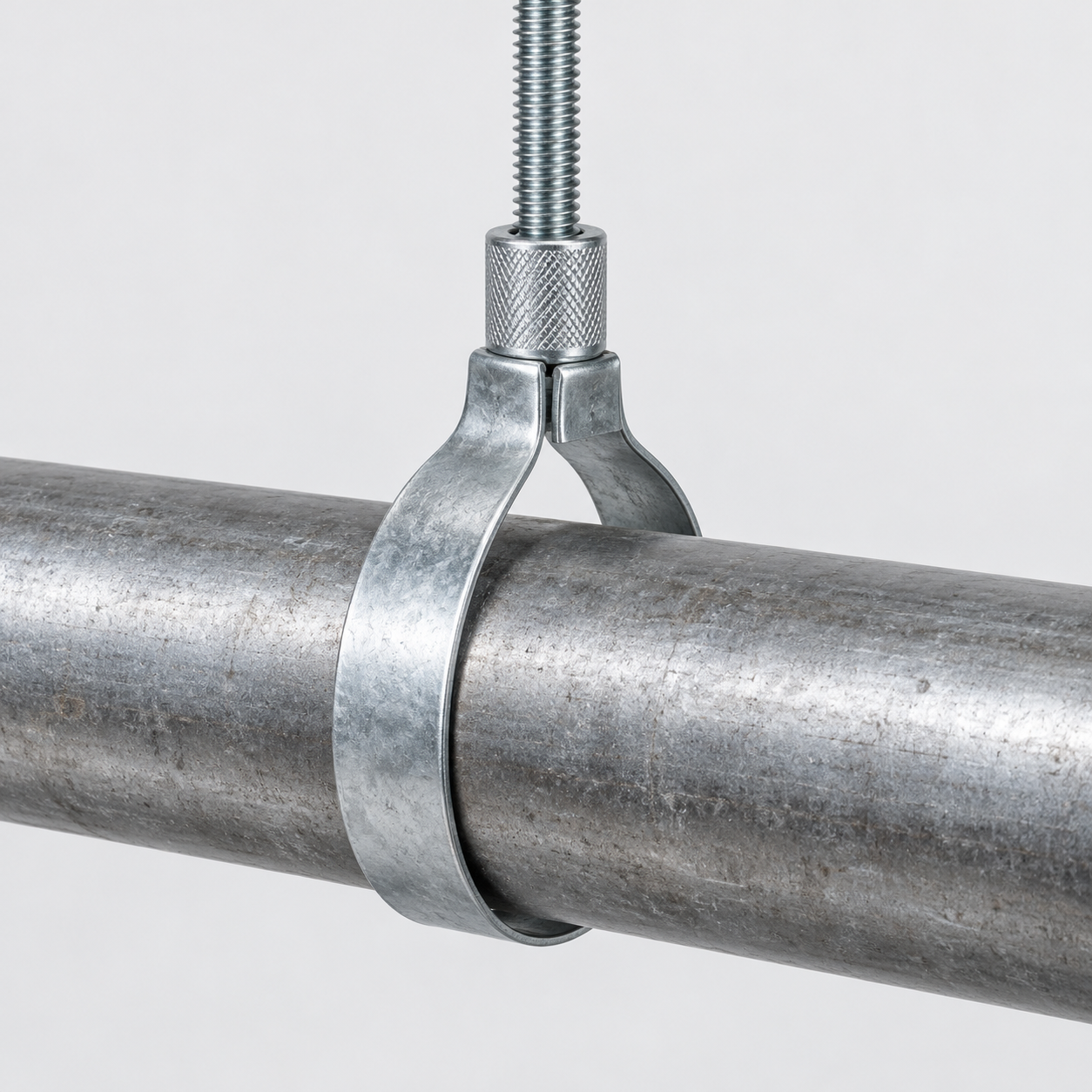
The product is also called a swivel loop hanger, adjustable band hanger, or adjustable swivel ring hanger. In this page, the preferred term is adjustable swivel loop hanger: a relatively thin formed band encircles the pipe, and the band ends retain a threaded nut at the crown. A vertical hanger rod engages that nut. Rotating the nut or threaded connection, as permitted by the selected design, provides vertical adjustment after the piping is positioned.
This terminology matters because a loop hanger is not automatically interchangeable with every product called a ring clamp. A split cast ring, hinged extension clamp, clevis hanger, riser clamp, cushioned clamp, and U-bolt all transfer load differently. The project specification should identify the intended hanger type rather than relying only on a broad phrase such as “pipe clamp.”
Where is the swivel action located?
The swivel feature is at the top threaded connection, not between the band and pipe. It helps the suspension rod align with the hanger crown and allows controlled elevation adjustment. It does not mean that the pipe is designed to slide freely, rotate continuously, or absorb seismic displacement. Thermal movement, lateral restraint, sway bracing, and seismic bracing are separate engineering questions.
What pipe service is this hanger intended for?
Industry products in this family are commonly specified for stationary, non-insulated pipe. A buyer should not assume that the same band is suitable for hot insulated piping, cryogenic lines, dynamic machinery piping, or a line requiring an engineered slide. Insulation shields, saddles, liners, movement hardware, and load distribution may change the required support type.
Information for Buyer Confirmation
| Quotation parameter | Information for Buyer Confirmation |
|---|---|
| Pipe identity | NPS or DN plus the actual finished pipe outside diameter; state pipe material and whether coating is included in the measured OD |
| Pipe condition | Bare or insulated, stationary or moving, horizontal orientation, surface sensitivity, and any CPVC or other nonmetallic-pipe compatibility requirement |
| Band geometry | Inside diameter or approved fit, band width, thickness, overall height, crown form, edge treatment, and required installation opening |
| Suspension connection | Rod diameter, thread system and pitch, engagement requirement, insert-nut form, nut-retention method, and mating rod material/finish |
| Loads | Design vertical load, dead load, insulation/fluid allowance, occasional loads, safety/design factors, and the governing support calculation or schedule |
| Operating conditions | Minimum and maximum metal temperature, indoor/outdoor exposure, corrosive agents, humidity, washdown, and fire-protection system requirements if applicable |
| Material | Specified carbon-steel or stainless-steel grade for the band and insert nut; identify any required traceability or heat documentation |
| Finish | Coating standard, process, class or thickness, supplementary treatment, color if relevant, and treatment for the formed band, nut, and mating rod |
| Standards and approvals | Applicable drawing, ANSI/MSS SP-58 type when required, and any project-specific listing, approval, inspection, or submittal requirement |
| Commercial input | Quantity, packaging, marking, inspection level, samples, destination requirements, and requested documentation |
Customization Note: YOUNGLEE sizes the hanger to the approved pipe OD and project inputs. When inch dimensions are supplied, preserve every stated decimal place and convert only by multiplying by 25.4; do not round the inch value before conversion to millimetres.
Why Actual Pipe Outside Diameter Controls Selection
NPS and DN identify a nominal pipe size; they do not by themselves state the finished outside diameter, coating buildup, or insulation envelope. The loop must be selected around the actual support interface. A band that is too small can force the opening, distort the crown, damage a coating, or prevent proper nut alignment. A band that is too large can create poor bearing contact and an unintended installation geometry.
For a bare metallic pipe, provide nominal size and actual OD. For coated pipe, identify whether the coating changes the fit. For insulated pipe, do not simply enlarge a bare-pipe loop: the support may require an insulation shield, load-bearing insert, vapor-barrier detail, or a different hanger family. For CPVC or another plastic material, the pipe manufacturer’s support spacing, temperature, edge-contact, and chemical-compatibility requirements remain controlling.
How should inch dimensions be converted?
Record the original inch value exactly as issued. A value written with two, three, or four decimal places must retain those decimal places in the source record. Multiply that unchanged value by 25.4 to obtain millimetres. Premature rounding can change the resulting fit, hole alignment, or thread-related dimension.
Band, Nut, and Thread Design
Formed band
The band carries pipe reaction around the lower arc and transfers it to the crown. Band width, thickness, material strength, formed radii, edge condition, and crown reinforcement all affect deformation and local pressure. A wider or thicker band is not automatically an approved substitute, because forming behavior, hole or slot details, nut retention, and load path must be evaluated together.
Captured swivel insert nut
A retained nut reduces the chance of losing the threaded component during handling and helps keep the suspension connection centered. Retention may be achieved by formed flares, tabs, or another drawing-defined feature. Retention is an assembly feature, not proof of a load rating or vibration qualification. Thread engagement and nut material still require confirmation.
Threaded suspension rod
The rod thread must match the insert nut in diameter, pitch, thread system, class, and usable engagement. The supporting structure, anchor, rod, coupler, nut, hanger, and pipe interface form one load path. The hanger itself does not create an automatic safe working load for the complete support. The weakest qualified component and the project design rules govern.
Material and Finish Selection
| Option | Useful selection basis | Important qualification |
|---|---|---|
| Carbon steel with project-specified zinc finish | Common starting point for indoor or controlled industrial service; economical and compatible with formed-band production | State whether the band starts from coated sheet or receives a post-forming finish. Coating damage at bends and cut edges requires review. |
| Electroplated zinc hardware | Useful where a specified fastener coating system and clean threaded finish are required | ISO 4042:2022, including Amendment 1:2026 where contractually applicable, addresses electroplated fastener systems and hydrogen-embrittlement risk. ASTM B633-23 covers electrodeposited zinc on iron and steel but directs mechanical-fastener users to consider ASTM F1941/F1941M. |
| Stainless steel | Consider for wet, washdown, marine-influenced, or chemically corrosive environments after compatibility review | Grade, property requirements, galling control, mating rod and nut, surface finish, and chloride exposure must be specified. Stainless steel is not a universal corrosion solution. |
| Alternative coating system | May be considered for an environment not adequately addressed by a basic zinc finish | Specify the exact coating, pretreatment, thickness, topcoat or sealer, curing limits, thread allowance, and repair criteria. Trade names alone are insufficient. |
Customization Note: Material and finish options are conditional. YOUNGLEE does not infer a coating life, corrosion category, temperature limit, or fastener property class from a generic finish name; those requirements must be stated and technically reviewed.
Why all components must be coordinated
The loop, insert nut, suspension rod, washers or locknuts, anchor, and supporting steel should form a complete corrosion-resistant system for the stated environment. Mixed metals can create galvanic concerns when an electrolyte is present. Coating thickness can also affect thread fit. The final purchase description should therefore cover the whole support chain rather than the visible band alone.
Loop Hanger Compared with Other Pipe Supports
| Support type | Distinct construction | Choose it when | Do not assume |
|---|---|---|---|
| Adjustable swivel loop hanger | Thin band encircling one pipe, with a top swivel insert nut for vertical rod suspension | A compact overhead support is needed for a stationary, generally non-insulated horizontal pipe | It is a slide, restraint, seismic brace, or insulated-pipe shield |
| Adjustable clevis hanger | U-shaped yoke, lower pipe cradle, and transverse pin or bolt | A deeper hanger geometry and removable lower connection are required | Its pin, rod, and allowable-load data can be transferred to a loop hanger |
| Split or hinged ring | Two-piece, cast, forged, or hinged ring that opens around an installed pipe | Post-installation access or a rigid split-ring form is required | Every split ring has the same temperature, restraint, or vibration function |
| Riser clamp | Two halves or a formed clamp with bearing ears that transfer vertical-pipe load to a floor or structure | A vertical pipe must bear at a penetration or structural level | It serves the same overhead suspension function as a loop hanger |
Customization Note: The comparison is functional, not a substitution schedule. The piping designer must select the support type and spacing from the system load, temperature, movement, material, insulation, code, and structural attachment.
For a deeper-yoke overhead arrangement, compare the adjustable clevis pipe hanger. For vertical-pipe bearing, review the two-bolt riser clamp. Where the project instead needs a simple pipe-to-frame fastener, the zinc-plated U-bolt pipe clamp has a different two-leg clamping geometry.
Installation and Engineering Review
Keep the rod aligned with the hanger crown
The threaded rod should enter the swivel insert without cross-threading or side loading. Misalignment can distort the crown and reduce thread engagement. The rod must not be used to force the pipe laterally into position. Structural attachment points should be located so the hanger carries the intended vertical reaction.
Check bearing and edge contact
The pipe should bear smoothly on the lower loop. Burrs, sharp edges, weld spatter, coating lumps, and local band damage should be rejected or corrected under the project procedure. A sensitive pipe material may require flared edges, a compatible lining, or another support design. Adding an unqualified liner changes fit, friction, temperature response, and load distribution.
Do not use the loop as an unintended restraint
A close-fitting hanger may limit lateral movement, but that observation is not a restraint rating. If the line requires a guide, anchor, sway brace, seismic restraint, surge restraint, or vibration isolator, identify that function explicitly and specify the corresponding engineered hardware.
Standards and Reference Data
ANSI/MSS SP-58-2018 consolidates industry guidance for pipe hanger and support materials, design, manufacture, selection, application, installation, and type definitions. Commercial Type 10 swivel-loop products from established manufacturers illustrate the market identity of this support family. Their catalog sizes, loads, temperatures, listings, and proprietary details remain supplier-specific and are not represented as YOUNGLEE performance data.
Likewise, coating standards govern defined processes and requirements; they do not by themselves establish the load capacity or service life of an assembled hanger. Any requested UL, FM, LPCB, fire-protection, or project approval must be explicitly stated. It is not inferred from appearance, terminology, or similarity to an industry product.
Generated Representative Product Image
The featured image is a generated representative visual created for this page. It shows one bare horizontal steel pipe held by one silver formed loop band, with two band ends meeting beneath one knurled top insert nut and one vertical threaded rod. It contains no third-party product photograph, logo, text, or watermark. The image does not verify exact dimensions, material grade, coating process, load rating, temperature, listing, certification, prior supply, or project suitability.
Frequently Asked Questions
Is a swivel loop hanger the same as a clevis hanger?
No. A swivel loop hanger uses a formed band and a top threaded insert. A clevis hanger uses a yoke and a transverse lower pin or bolt. They have different geometry, installation steps, and selection data.
Can the hanger be used on insulated pipe?
Not by assumption. Common loop hangers are intended for stationary non-insulated pipe. An insulated line may need a shield, load-bearing insulation insert, vapor-barrier detail, or another hanger type sized around the engineered support interface.
Does the swivel nut allow pipe movement?
The swivel nut provides alignment and vertical adjustment at the rod connection. It does not automatically qualify the hanger as a sliding support, guide, expansion device, seismic restraint, or vibration isolator.
Can YOUNGLEE manufacture metric and inch-thread versions?
Metric, UNC, or another agreed thread system can be reviewed against the drawing, nut geometry, rod size, engagement, load, and production quantity. Mixed thread systems must be avoided.
What determines the allowable load?
The support load path includes the building attachment, anchor, threaded rod, couplers and nuts, swivel insert, formed band, pipe interface, and installation condition. Allowable load must come from the approved design basis, applicable testing or calculation, component data, and required safety factors—not from appearance or pipe size alone.
Request a Quotation from YOUNGLEE
Send the actual pipe OD plus NPS or DN, pipe material and condition, band dimensions, rod thread, insert-nut requirement, material grade, finish specification, quantity, operating temperature, corrosion environment, design loads, applicable standard, inspection documents, and drawing. YOUNGLEE will review production to the approved drawing or agreed standard, including custom dimensions, material selection, forming details, surface treatment, packaging, and project-specific technical requirements.