A three-bolt pipe clamp is a formed-metal pipe attachment for suspending horizontal insulated piping. Two curved clamp halves grip the pipe with an inner upper bolt and a lower bolt, while a separate outer load bolt transfers the pipe weight to an eye rod, weldless eye nut, or engineered hanger connection from a point outside the insulation. YOUNGLEE supplies drawing-controlled carbon-steel, alloy-steel, and stainless-steel configurations for power, process, petrochemical, refinery, utility, and industrial piping. Pipe size, actual outside diameter, load, operating temperature, insulation thickness, material, fasteners, finish, hanger interface, and inspection requirements are customized to the approved project drawing; no universal load or temperature rating is implied.
Three-Bolt Pipe Clamp at a Glance
| Selection item | YOUNGLEE supply basis | Information for Buyer Confirmation |
|---|---|---|
| Product type | Two formed clamp halves with two clamping bolts and one separate load bolt | Three-bolt clamp geometry, hanger arrangement, and project type designation |
| Primary function | Attachment for suspending horizontal pipe, commonly where insulation must continue around the pipe and below the hanger connection | Operating, occasional, test, installation, and support movement load cases |
| Pipe definition | Custom fit to the stated nominal pipe size and actual outside diameter | NPS or DN, pipe schedule, actual OD, tolerance, and any non-standard outside diameter |
| Material options | Carbon steel, project-specified alloy steel, or stainless steel, subject to manufacturing review | Material specification, grade, condition, design temperature, corrosion environment, and traceability |
| Fasteners | Compatible studs or bolts, nuts, washers, and load-bolt spacer where required by the drawing | Fastener grades, thread system, locking method, coating, temperature basis, and documentation |
| Finish options | Plain, painted, zinc-plated, hot-dip-galvanized, or project coating where compatible with material and temperature | Finish standard, thickness or class, temperature limit, thread fit, and field-repair procedure |
| Standards basis | May be manufactured to an approved project drawing or an applicable MSS SP-58 Type 3 arrangement | Exact standard, edition, figure, dimensional series, and acceptance requirements |
| Customization | Clamp radius, bar width and thickness, ear geometry, bolt spacing, load-bolt position, insulation clearance, and connection details | Complete dimensioned drawing, quantity, inspection plan, marking, and packaging |
Customization Note: The table identifies design inputs and available manufacturing choices, not a stock dimensional series or guaranteed performance envelope. Final dimensions, materials, allowable load, temperature, insulation clearance, fasteners, finish, and hanger connection must be approved for the actual piping system before production.
How Does a Three-Bolt Pipe Clamp Work?
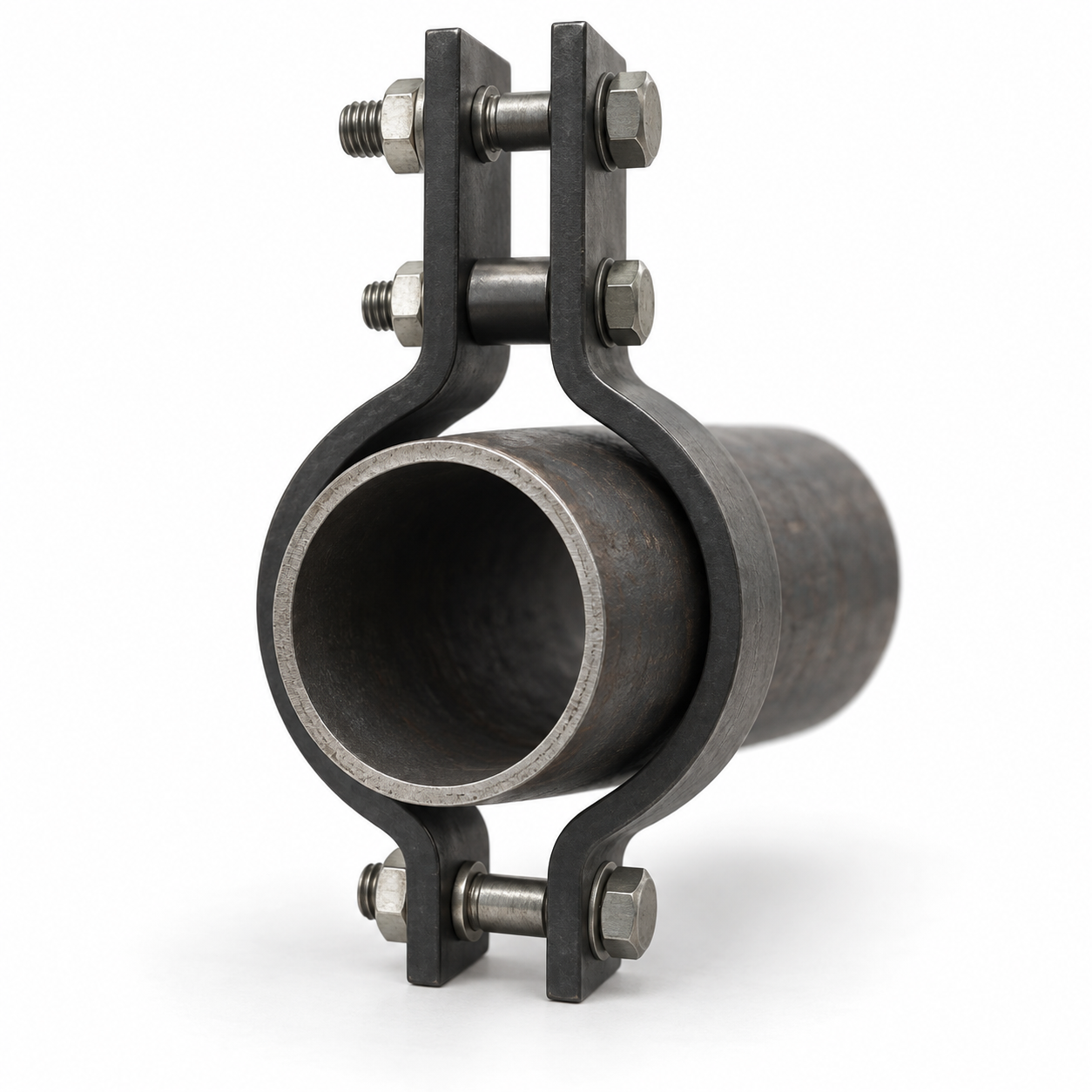
The name refers to three separate transverse bolt positions, not to three identical fasteners performing the same job. The lower bolt and the inner upper bolt draw the formed halves around the pipe. The outer upper bolt is the load bolt: it passes through extended ears above the pipe and provides the attachment point through which the supported weight enters the remainder of the hanger assembly.
This separation of functions is important. The clamping bolts establish pipe contact and assembly geometry. The load bolt transfers force to an eye component, hanger rod, spring support, or other engineered connection. Locating that load transfer above the pipe can leave space for thermal insulation and its outer covering. The load bolt, spacer, eye component, and insulation envelope must therefore be coordinated on the support drawing rather than selected independently.
Why is the third bolt outside the insulation?
For horizontal insulated piping, the hanger connection must remain accessible and must not crush or interrupt the insulation unnecessarily. In the MSS terminology for a Type 3 three-bolt pipe clamp, the separate load bolt transfers weight from a point outside the insulation. The required ear extension depends on the insulation thickness, jacket, load-bolt diameter, spacer, eye connection, installation access, and movement allowance.
Is a three-bolt clamp the same as a double-bolt clamp?
Industry terminology can be confusing. Older catalogs may call this arrangement a double-bolt pipe clamp because two bolts clamp the halves to the pipe, while the third bolt is treated as a load bolt. Current project documents may instead use three-bolt pipe clamp or MSS SP-58 Type 3. The purchase specification should include a drawing or figure reference so the requested structure is unambiguous.
Three-Bolt, Two-Bolt, and Clevis Hanger Comparison
| Attachment | Typical load path | Where it is useful | Key limitation |
|---|---|---|---|
| Three-bolt pipe clamp | Pipe contact through two curved halves; separate upper load bolt connects outside the insulation | Horizontal insulated piping, elevated-temperature service, and engineered hanger or spring connections | Material, bar section, bolt set, ear extension, load, temperature, and insulation clearance are drawing-specific |
| Two-bolt pipe clamp | Two formed halves connect at opposed ears; hanger connection depends on the selected figure | Heavy pipe attachment where the selected design provides the required connection and insulation space | A superficially similar shape does not establish Type 3 function or equivalent insulation clearance |
| Adjustable clevis hanger | Pipe bears in a lower yoke suspended by a cross bolt and upper connection | Horizontal pipe where vertical adjustment and a conventional clevis arrangement are appropriate | It does not grip the pipe in the same way and may require insulation protection or a separate saddle |
| Riser clamp | Clamp ears bear on structure or receive load from pipe shear lugs, depending on the design | Vertical pipe support at floors, platforms, or structural openings | Vertical support behavior is not interchangeable with a horizontal three-bolt hanger attachment |
Customization Note: These descriptions explain common functions only. The piping and structural designers must establish the actual load path, degrees of freedom, insulation system, connection detail, and allowable reactions. YOUNGLEE manufactures the approved arrangement and does not assign support behavior from appearance alone.
Material Selection for Temperature and Corrosion
Material selection starts with the metal temperature at the clamp, not only the process-fluid temperature. Insulation, heat transfer, operating cycles, ambient conditions, and the position of the clamp relative to the insulation all affect the component temperature. Published supplier catalogs show that carbon-steel and chromium-molybdenum alloy three-bolt clamps can have very different temperature ranges and allowable loads. Those catalog values belong to the stated proprietary figures and must not be transferred to a custom YOUNGLEE clamp without engineering confirmation.
Carbon steel is a practical basis for many moderate-temperature industrial supports. Alloy steel may be specified when elevated-temperature strength and the project material rules require it. Stainless steel may be selected for corrosion resistance or a project material system, but grade, temperature strength, galling risk, nut compatibility, surface condition, and galvanic contact still require review. The clamp body and fasteners are separate specification items; using an alloy clamp body does not automatically define the bolt or nut grade.
Coating limits matter
Finish selection must account for service temperature and the base material. A galvanized or zinc-plated option should not be assumed suitable merely because it improves atmospheric corrosion resistance. The project must define the coating standard, maximum metal temperature, thickness, thread allowance, hydrogen-embrittlement controls where relevant, touch-up method, and compatibility with the insulation and jacketing. Plain alloy steel, a project coating, or stainless construction may be more appropriate in some services, but each requires an approved specification.
Dimensions and Quotation Inputs
Nominal pipe size is necessary for identification, but the formed radius must be checked against the actual pipe outside diameter and tolerance. Non-standard pipe, lined pipe, heavy-wall construction, or a project-specific spacer arrangement may change the clamp geometry. The insulation thickness does not increase the clamp bore when the clamp contacts the pipe directly; instead, it affects the height and spacing of the extended upper ears and the location of the separate load bolt.
Every dimension shown in inches should be provided exactly as issued. YOUNGLEE preserves every decimal place supplied and multiplies the unrounded inch value by 25.4 for millimetre conversion. Rounding an inch dimension before conversion can produce an avoidable fit error in bolt spacing, bar length, insulation clearance, or pipe contact.
Required drawing dimensions
- Nominal pipe size, actual outside diameter, tolerance, pipe schedule, and any special surface or overlay.
- Clamp inside radius or diameter, bar width, bar thickness, developed length, and forming tolerances.
- Upper and lower ear lengths, hole diameters, hole spacing, edge distances, and alignment tolerances.
- Inner upper clamping bolt, lower clamping bolt, and outer load-bolt diameters, lengths, threads, nuts, and washers.
- Load-bolt spacer length and diameter, eye-rod or eye-nut interface, thread projection, and assembly clearances.
- Insulation thickness, jacket thickness, required gap around the hanger connection, and installation access.
- Finish allowance, marking location, weld restrictions if any, and dimensional inspection points.
Engineering Data Needed Before Manufacture
| Project input | Why it matters | How it affects the clamp |
|---|---|---|
| Load cases | Operating, test, occasional, installation, and fault conditions may govern different components | Bar section, bolt sizes, spacer, eye connection, allowable stress, and hanger interface |
| Metal temperature | Allowable stress and coating suitability change with temperature | Body material, fastener grades, finish, heat treatment, and documentation |
| Insulation system | Thickness, jacket, compression resistance, and access define the required external connection position | Upper-ear extension, load-bolt location, spacer, and installation clearance |
| Pipe movement | Thermal movement can rotate or misalign a hanger and can change reactions | Eye connection, rod articulation, spring or rigid support interface, and clearance |
| Pipe wall and local stress | Clamp contact can introduce local pressure and bending | Wrap, bar width, fit, tightening control, and any required stress evaluation |
| Environment | Outdoor, marine, chemical, or wet insulation exposure affects corrosion risk | Material, coating, isolation, drainage, inspection, and packaging |
| Inspection level | Traceability and acceptance requirements must be planned before cutting and forming | Material certificates, heat numbers, dimensional reports, NDE, coating records, and witness points |
Customization Note: The table is an RFQ and design-review checklist, not a calculation or certified capacity table. The responsible engineer must define the design loads, allowable stresses, temperature basis, pipe local-stress acceptance, hanger movement, and structural connection. Final values require drawing and project approval.
Manufacturing and Inspection Controls
YOUNGLEE can manufacture the curved halves, extended ears, bolt holes, spacer, and compatible hardware to the approved drawing. Important production controls include material identification, plate or bar thickness, forming radius, ear parallelism, hole location, edge condition, heat-treatment requirements, thread form, fastener identity, coating allowance, and trial assembly. Forming and any thermal treatment must follow the material specification and project procedure, especially for alloy steels used at elevated temperature.
Inspection can include material certificates when ordered, dimensional reports, visual examination, thread gauging, coating documentation, positive material identification, hardness checks, or other project-defined tests. Nondestructive examination, proof loading, high-temperature qualification, weld procedure approval, third-party inspection, and certification are not implied. They must be specified before quotation so the manufacturing and quality plan can be reviewed.
Installation Considerations
- Verify pipe identity, actual OD, clamp marking, fastener grades, and support location before assembly.
- Orient the two formed halves and all three bolt positions exactly as shown on the approved drawing.
- Keep the outer load bolt, spacer, eye component, and hanger rod clear of the insulation jacket and adjacent steelwork.
- Tighten the clamping bolts using the specified sequence, installed dimension, or torque rule; do not assume that maximum tightening is correct.
- Confirm that the hanger can articulate or move as designed and that the insulation is not carrying structural load unless the system was engineered for it.
- After installation, inspect thread engagement, nut locking, clamp fit, coating damage, pipe contact, insulation closure, and load-bolt alignment.
Frequently Asked Questions
Does a three-bolt pipe clamp always meet MSS SP-58 Type 3?
No. Three visible bolts do not prove compliance. The project must specify the applicable MSS SP-58 edition, Type 3 arrangement, materials, design loads, dimensions, manufacturing requirements, and acceptance criteria. YOUNGLEE can review manufacture to an approved standard-based drawing.
Can the clamp be used without insulation?
A three-bolt arrangement can be designed for different services, but its main procurement distinction is the separate load bolt and the ability to place the hanger connection outside an insulation envelope. If little or no insulation is required, a two-bolt clamp, clevis hanger, or another support may be simpler. The engineer should select the attachment from the load path rather than from bolt count alone.
Can YOUNGLEE provide alloy-steel clamps for high temperature?
Project-specified alloy steel can be reviewed when the material grade, product form, heat treatment, allowable-stress basis, fastener grades, design temperature, loads, dimensions, and documentation are supplied. A catalog temperature from another manufacturer’s figure is not used as a YOUNGLEE rating.
What is the difference between the load bolt and the clamping bolts?
The two clamping bolts draw the formed halves around the pipe. The separate load bolt connects the clamp to the hanger assembly and transfers supported weight. The load bolt and spacer therefore require their own material, diameter, thread, clearance, and connection checks.
What should be included with an RFQ?
Send the nominal pipe size and actual OD, schedule, clamp figure or drawing, design loads, operating and design temperatures, insulation and jacket thicknesses, material and fastener specifications, finish, eye or rod connection, movement requirements, quantity, documentation, testing, inspection, marking, and packaging requirements.
Related Pipe-Support Arrangements
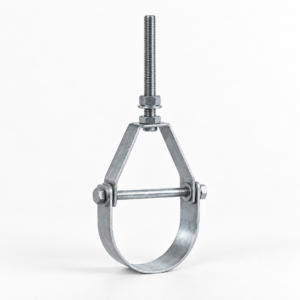
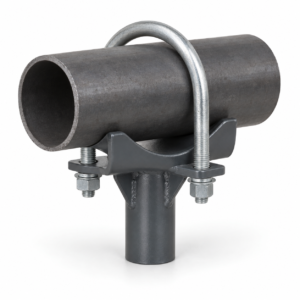
For a conventional suspended yoke with vertical adjustment, compare YOUNGLEE’s adjustable clevis pipe hanger. A heavy two-piece clamp manufactured to a DIN dimensional basis is covered separately on the hot-dip-galvanized DIN 3567 pipe clamp page. Where the pipe is supported from below on a floor-mounted pedestal, the pipe saddle support with U-bolt follows a different load path.
Representative Image Notice
The featured image is a generated representative product visual. It shows two dark formed-steel clamp halves around a short horizontal steel pipe, with a lower clamping bolt, an inner upper clamping bolt, and a separate outer load bolt with spacer. Insulation is intentionally omitted so the three-bolt structure remains visible. The image does not prove a material grade, exact dimensions, surface treatment, load rating, temperature limit, MSS classification, test result, certification, or previous project supply.
Request a Drawing-Based Quotation
Send YOUNGLEE the pipe OD and schedule, three-bolt clamp drawing or required standard and edition, design loads, operating and design temperatures, insulation system, material and fastener grades, finish, hanger connection, movement, quantity, inspection plan, and documentation requirements. YOUNGLEE will review the formed-bar geometry, three bolt positions, spacer, hardware, material route, coating, and manufacturability before quotation. Final support suitability remains subject to project engineering approval.