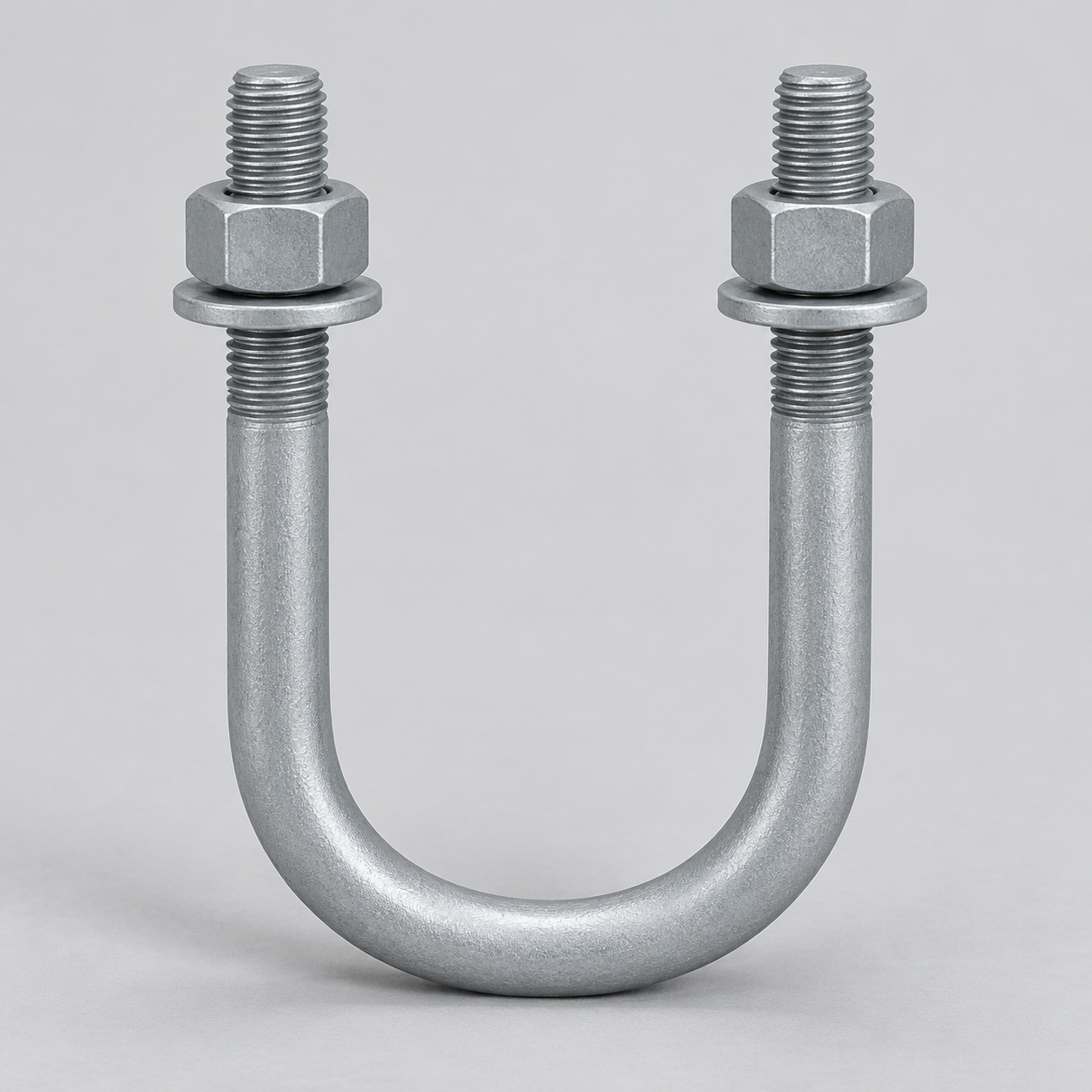
A zinc-flake coated U-bolt is a formed steel fastener protected by a non-electrolytically applied zinc-flake coating system. YOUNGLEE supplies custom round-bend U-bolts with matched nuts and washers for pipe hold-down, guide, restraint and equipment-mounting duties where the purchase specification calls for this thin-film corrosion-protection route. The coating may include a zinc or zinc-aluminium basecoat, a topcoat and controlled lubricant, but the exact system must be identified rather than ordered by colour alone. U-bolt geometry, steel grade, thread fit, coating process, friction requirement, corrosion test and curing limits are reviewed together. Metric and inch dimensions can be manufactured to an approved drawing or applicable standard.
Image note: the featured image is a generated representative catalog visual. It shows the general silver-grey U-bolt, nut and washer configuration; it does not verify a coating chemistry, thickness, friction coefficient, corrosion-test result, material grade, dimension, certification, stock item or previous YOUNGLEE project.
Zinc-Flake Coated U-Bolt at a Glance
| Selection Item | Typical YOUNGLEE Supply Basis | Information for Buyer Confirmation |
|---|---|---|
| Product type | Round-bend carbon- or alloy-steel U-bolt with nuts and washers | Actual application, quantity, drawing and installation arrangement |
| Coating family | Non-electrolytically applied zinc-flake system; zinc-aluminium systems are available where specified | Standard, approved coating system, basecoat, topcoat, lubricant and colour |
| Applicable coating standards | ISO 10683:2018 or ASTM F3393-24 where their scope and project requirements apply | Required standard, edition, classification, test methods and acceptance criteria |
| U-bolt geometry | Custom rod diameter, inside width, leg length, thread length, bend radius and hardware | Actual pipe OD, grip or guide clearance, support thickness and dimensioned drawing |
| Thread system | Metric or Unified inch thread to the confirmed drawing | Nominal size, pitch/TPI, class, coating allowance, nut fit and engagement |
| Finish performance | Specified for the complete coating system and test basis, not inferred from appearance | Coating thickness, friction range, corrosion test, curing limit, damage and repair criteria |
| Inspection | Dimensional, visual and thread-fit checks; coating verification as ordered | Sampling, thickness method, corrosion test, friction test, certificates and ITP |
Customization Note: The configurations and technical items above are for selection and quotation reference. Actual dimensions and coating requirements vary with the applicable standard, actual pipe outside diameter, grip or non-grip function, support thickness, thread allowance, installation arrangement, steel strength and project environment. YOUNGLEE can manufacture U-bolts to customer drawings, specifications, samples or confirmed installation conditions. Buyers may specify rod material, rod diameter, thread, inside width, leg length, thread length, bend radius, zinc-flake system, topcoat, lubricant, hardware and inspection requirements subject to technical review.
What Makes a Zinc-Flake System Different?
Zinc-flake coatings are applied from a fluid dispersion and cured to form a thin protective matrix containing zinc flakes and, in some systems, aluminium flakes. This is different from electrodepositing metallic zinc or zinc-nickel onto the U-bolt, and it is different from immersing the part in molten zinc for hot-dip galvanizing. The distinctions matter because the processes have different coating builds, thread-fit considerations, pretreatments, curing cycles, friction controls and acceptance standards.
The basecoat provides the principal sacrificial and barrier protection. A compatible topcoat can add colour, chemical resistance, handling durability or friction control. Lubricant may be integral or separately applied. Calling the finish “zinc flake” therefore does not fully define a purchasable system. The coating specification should identify each required layer and the approved applicator route.
Which Standard Should the Buyer Specify?
ISO 10683:2018 covers non-electrolytically applied zinc-flake coating systems for steel fasteners, with or without a topcoat and with or without lubricant. Its scope includes ISO metric threaded fasteners, non-ISO metric threads and certain non-threaded fasteners. ASTM F3393-24 covers classification, performance and basic requirements for non-electrolytically applied zinc-flake systems on Unified inch and metric threaded fasteners within its stated minimum nominal diameters. ASTM F3393-24 requires the system it covers to be free of hexavalent chromium.
The standards should not be combined casually. The purchase order should select one governing route or clearly state how requirements are reconciled. Neither coating standard defines the U-bolt’s inside width, leg length, bend radius, installed grip, allowable pipe-support load or tightening procedure. For inch-series bent-bolt geometry, ASME B18.31.5 may provide an ordering framework; custom geometry can instead be controlled by the approved drawing.
How Does the Process Affect Hydrogen-Embrittlement Risk?
A non-electrolytic zinc-flake process is commonly selected for susceptible high-strength fasteners because the coating deposition itself does not require electrolytic plating. ISO 10683 specifically notes use on high-strength fasteners to avoid internal hydrogen-embrittlement risk. This advantage must still be stated carefully: inappropriate acid cleaning, prior processing, material condition, forming damage or another manufacturing step can introduce separate risk. The agreed process route should therefore control cleaning and pretreatment as well as coating application.
Steel grade and strength are not established by the coating name. The buyer should specify the base-material standard, mechanical-property requirements, forming sequence, heat treatment where applicable, and any hydrogen-embrittlement controls. A zinc-flake coating cannot repair cracks, decarburization, an unsuitable bend radius or damage already present in the U-bolt.
Why Friction and Thread Fit Need Their Own Requirements
Coating thickness must be considered on both the external U-bolt threads and the mating nut threads. Excessive build, coating accumulation, incompatible nut finish or incorrect allowance can cause interference or reduce usable engagement. Finished assemblies should be checked with the specified mating hardware after coating.
Topcoat and lubricant also affect the relationship between installation torque and bolt tension. A corrosion requirement does not automatically define a coefficient of friction, and a supplier’s friction result for one product cannot be transferred to another coating stack. If clamp force or preload matters, the purchase specification should state the friction test, target range, mating hardware, tightening method and permitted number of assembly cycles. A generic torque value is not suitable for every zinc-flake system.
Zinc Flake, Zinc-Nickel and Hot-Dip Galvanizing Compared
| Finish Route | Selection Direction | Important Boundary | Information for Buyer Confirmation |
|---|---|---|---|
| Zinc-flake system | Thin non-electrolytic system considered where the specified fastener standard, corrosion performance and hydrogen-risk controls favour it | Basecoat, topcoat, lubricant, cure and friction are system-specific | ISO 10683 or ASTM F3393 classification, approved system, thickness and tests |
| Zinc-nickel electroplate | Electrodeposited zinc-alloy system selected to an electroplating specification | Pretreatment and hydrogen-embrittlement controls remain important for susceptible steels | Alloy deposit, passivation, sealer, thickness, baking and friction |
| Conventional zinc electroplate | Common thin metallic finish for indoor or moderately protected service when the project accepts it | Do not infer outdoor life or interchangeability with zinc flake from colour | Coating standard, thickness, passivation, sealer and exposure |
| Hot-dip galvanizing | Thicker zinc coating often selected for structural outdoor hardware | Coating build can require thread allowances and matched galvanized hardware | Applicable product standard, thread treatment, coating mass/thickness and repair |
Customization Note: This comparison is a selection guide, not a universal performance ranking. Final suitability depends on the base steel, part geometry, complete coating system, surface preparation, curing, thread fit, friction, handling damage, exposure and acceptance tests. YOUNGLEE can supply the U-bolt with the project-selected finish after the buyer confirms the applicable standard and coating specification.
How Should Corrosion Test Results Be Read?
ISO 9227 defines salt-spray test procedures, but it does not choose an exposure duration for a particular U-bolt or predict field service life. A requirement such as hours to white or red corrosion is meaningful only when tied to the exact coating system, thickness, substrate, pretreatment, cure, specimen condition, test method, evaluation point and acceptance rule. Cut edges, thread roots, handling marks and post-assembly damage may behave differently from an undamaged flat test panel.
YOUNGLEE therefore does not assign one universal salt-spray value or service life to every zinc-flake coated U-bolt. Buyers should state the project corrosion category or test requirement, whether white and red corrosion are evaluated separately, the sampling plan, and any cyclic, chemical or field-exposure requirement. Salt-spray testing is useful for quality control under defined conditions; it is not a standalone forecast of years in service.
Dimensions Required for a Buildable U-Bolt
| Dimension or Input | Why It Matters | Information for Buyer Confirmation |
|---|---|---|
| Actual pipe or member OD | Controls inside width, bend geometry and installed clearance | State actual OD; NPS or DN alone is not sufficient |
| Rod diameter and material | Affect threads, bendability, available section and coating process limits | Material standard, grade, strength, condition and corrosion allowance |
| Inside width and bend radius | Establish pipe fit and leg spacing | Finished coated dimension, tolerance and datum |
| Leg length and thread length | Accommodate support thickness, washers, nuts and adjustment | Overall or tangent datum, engagement and projection after assembly |
| Thread specification | Controls mating hardware and inspection gauges | Metric pitch or inch TPI, class, handedness and post-coating fit |
| Function and loads | Determine whether contact, clearance, uplift control or restraint is required | Grip, hold-down or guide duty; load directions, movement and tightening method |
| Coating details | Influence thread allowance, friction, colour and inspection | Basecoat, topcoat, lubricant, thickness, cure, tests and repair rule |
Customization Note: These are quotation inputs, not a universal stock-size table. Actual dimensions vary with pipe OD, U-bolt function, support thickness, thread engagement, coating allowance and installation arrangement. YOUNGLEE can manufacture to customer drawings, specifications, samples or confirmed conditions. If dimensions are supplied in inches, YOUNGLEE preserves every decimal place provided and converts to millimetres by multiplying the original inch value by exactly 25.4, without rounding the inch input first.
Grip, Hold-Down and Guide Arrangements
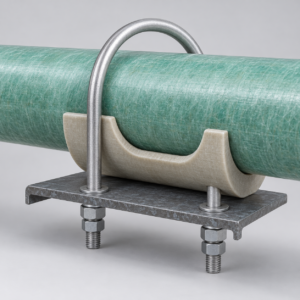
The coating does not decide the U-bolt’s installed function. A grip clamp is intentionally tightened to develop contact, while a hold-down arrangement is detailed for a stated uplift case. A non-grip guide normally uses controlled clearance so the pipe can move axially while lateral movement and uplift are limited. Each function needs its own nut position, support detail, load cases and installation instruction. Tightening a guide as though it were a grip clamp can defeat the movement design.
Manufacturing and Inspection Considerations
Production controls normally include material verification, forming to the approved radius, checking leg parallelism and inside width, inspecting threads before coating, controlling cleaning and cure, and verifying finished thread fit with the actual nuts. Rack, dip-spin or spray application may be selected by the approved coating processor according to part size, geometry, masking and finish requirements. The process choice should not be changed without reviewing the qualified system.
The inspection plan may specify coating-thickness measurement, visual criteria, adhesion, corrosion testing, friction testing, thread gauges, dimensional reports, material certificates and packaging protection. Parts should be packed to reduce metal-to-metal damage at the crown and threads. Inspection confirms conformity to the purchase specification; it does not create an unqualified safe working load for the complete pipe support.
Typical Applications
- industrial pipe hold-downs and restraints on channels, plates or support steel;
- non-grip pipe guides where coating thickness and functional clearance are coordinated;
- equipment, utility and renewable-energy mounting hardware exposed to project-defined corrosion conditions;
- high-strength fastener applications where the approved non-electrolytic coating route is preferred;
- custom machinery and structural assemblies requiring a thin, controlled coating system.
Marine splash zones, immersion, chemical exposure, high temperature, electrical isolation and fatigue-critical service require additional review. Zinc flake is not automatically a substitute for stainless steel, a dielectric sleeve, a fluoropolymer coating or a complete protective system for every environment.
Related U-Bolt Finish Options
For an electrodeposited alloy finish, compare the zinc-nickel plated U-bolt. For a conventional thin metallic coating, review the zinc-plated carbon-steel U-bolt. Where the base material is the primary high-temperature bolting decision, the ASTM A193 Grade B7 alloy-steel U-bolt explains why material grade and surface finish must be specified separately.
Frequently Asked Questions
Is zinc flake the same as galvanizing?
No. Zinc-flake coating is a non-electrolytically applied thin-film system. Hot-dip galvanizing forms a thicker zinc coating by immersion in molten zinc. Their standards, coating build, thread treatment and selection criteria differ.
Can a zinc-flake U-bolt be ordered by colour?
No. Silver-grey or black appearance does not identify the basecoat, topcoat, lubricant, thickness, friction or corrosion performance. Specify the approved coating system and acceptance requirements.
Does zinc flake eliminate every hydrogen-embrittlement risk?
No. Non-electrolytic application avoids the electrolytic deposition step, but base material, cleaning, pretreatment, forming and prior processing still require control. The complete manufacturing route must be reviewed for susceptible high-strength steel.
Can one salt-spray figure be used for every project?
No. Any corrosion-test requirement must identify the exact coating system, specimen condition, standard, exposure duration and evaluation criteria. Salt-spray hours do not directly predict field service life.
What should be sent with an RFQ?
Provide the actual pipe or member OD, rod material and diameter, thread, inside width, leg length, thread length, bend radius, nuts and washers, grip or guide function, loads, movement, coating standard and system, thickness, colour, friction and corrosion-test requirements, operating environment, quantity, drawing, inspection plan and documentation needs.
Request a Quotation
Send YOUNGLEE the approved drawing or complete dimensional schedule together with the base-material specification, coating system, mating hardware, installation function, environment and acceptance requirements. YOUNGLEE will review manufacturability, forming, thread allowance, coating route, inspection and packaging before confirming a custom zinc-flake coated U-bolt for production.