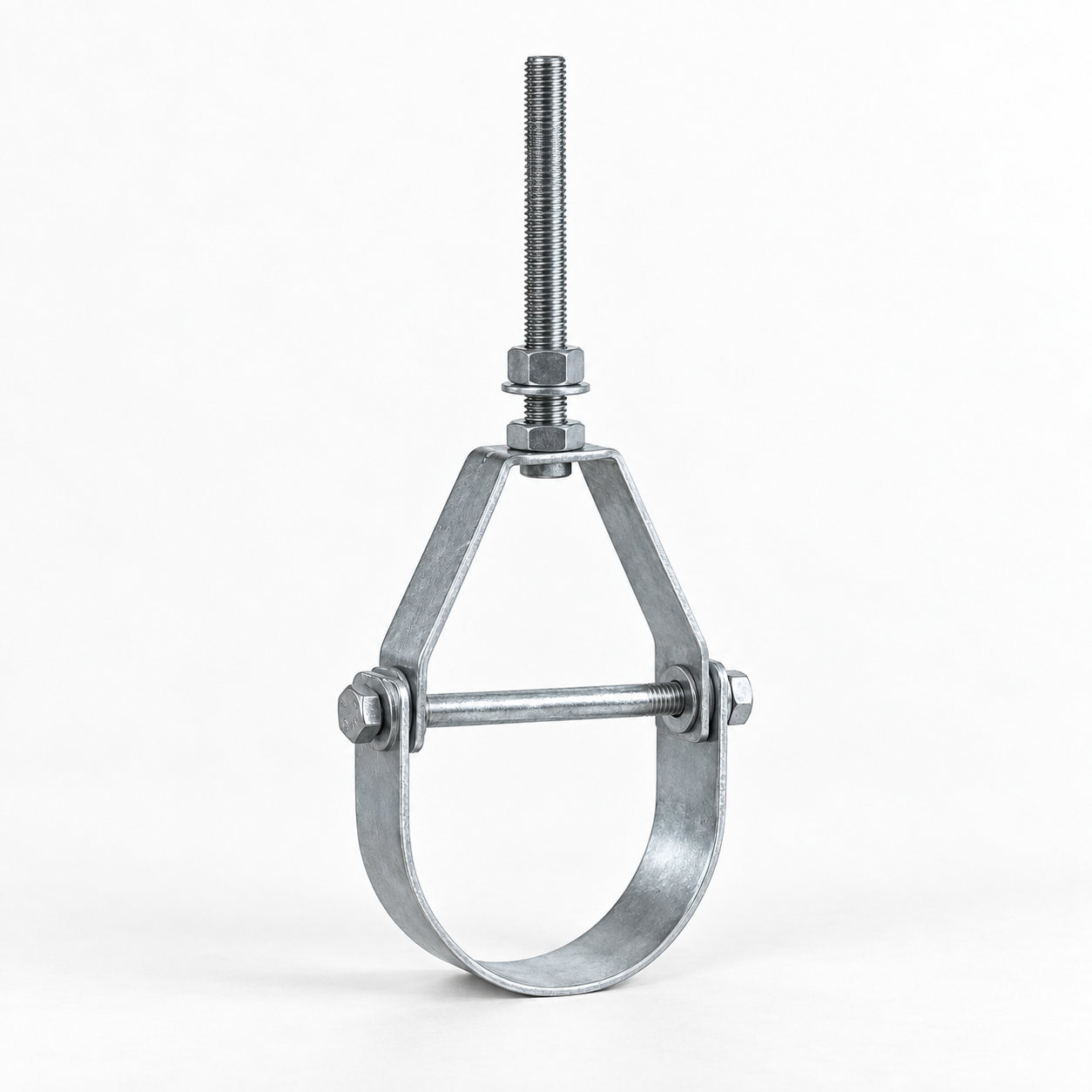
An adjustable clevis pipe hanger is a two-part metal suspension assembly that supports a horizontal stationary pipe from a threaded hanger rod while permitting controlled vertical positioning during installation. The upper yoke carries the suspension connection, and the lower curved strap cradles the pipe through a removable cross bolt. YOUNGLEE supplies custom carbon-steel and stainless-steel clevis hangers for industrial piping, building services, utilities, marine-related installations, and fabricated support systems. Pipe size, actual outside diameter, hanger-rod connection, band section, cross-bolt hardware, finish, insulation arrangement, load basis, and inspection documents are produced to an approved drawing or applicable project standard. Final load rating, temperature limit, spacing, movement allowance, and structural attachment remain design-specific.
Adjustable Clevis Pipe Hanger at a Glance
| Product fact | Available or typical project basis | Important qualification |
|---|---|---|
| Product type | Adjustable clevis hanger for suspended horizontal pipe | Commonly associated with MSS SP-58 Type 1 terminology when that standard and edition are specified |
| Main components | Upper yoke, lower curved strap, cross bolt or rod, nuts, washers, and hanger-rod connection | Hanger rod and structural attachment may be supplied separately unless included in the approved assembly |
| Common materials | Fabricated carbon steel; stainless-steel options for qualified projects | Grade, product form, weld requirements, and traceability must be stated |
| Finish options | Plain, zinc plated, hot-dip galvanized, painted, or project-specified coating | Finish selection depends on material, thread fit, environment, temperature, and inspection requirements |
| Service function | Suspension of stationary horizontal piping with installation-height adjustment | A clevis hanger is not automatically a restraint, guide, anchor, seismic brace, or variable spring support |
| Pipe condition | Bare pipe, coated pipe, or insulated pipe with an engineered shield or support arrangement | Insulation must not be crushed or treated as a load-bearing component unless the insulation system is designed for that duty |
| Size basis | NPS or DN together with actual pipe outside diameter and insulation details | Nominal pipe size and actual outside diameter are not interchangeable |
| Customization | Band geometry, rod connection, cross bolt, hardware, finish, clearance, and documentation | No universal stock range, load rating, or temperature limit is claimed |
Customization Note: YOUNGLEE finalizes every clevis hanger only after reviewing the pipe data, support function, design load cases, hanger-rod and structural attachment, material, finish, insulation system, environment, drawing, standard edition, and inspection requirements.
How Does an Adjustable Clevis Hanger Work?
The lower U-shaped strap supports the underside of the pipe. A horizontal cross bolt connects the lower strap to the two sides of the upper yoke, creating a removable cradle. The yoke transfers vertical reaction to the threaded hanger rod and then to the building steel or other approved structure. Adjustment nuts at the rod connection allow the installed elevation to be set within the geometry permitted by the approved design.
This load path is different from a U-bolt that clamps a pipe to a surface. A clevis hanger acts primarily as a suspended support. Tightening its hardware does not convert it into a fixed anchor, lateral restraint, or seismic brace. Those functions require separately engineered components and load paths.
What Does MSS SP-58 Type 1 Mean?
ANSI/MSS SP-58-2025 establishes an industry basis for pipe-hanger and support materials, allowable stresses, product design, testing, load ratings, selection, application, inspection, installation, and documentation. Adjustable clevis hangers are commonly identified in industry catalogs as Type 1. The type name helps define the support family, but it does not by itself prove that a particular custom hanger meets every dimensional, material, load, test, marking, or installation requirement of a specified edition.
If MSS SP-58 is required, the RFQ should state the edition, type, design conditions, required load rating, safety or acceptance basis, material and finish, inspection level, and documentation. YOUNGLEE will review those requirements before confirming compliance. Historical references such as MSS SP-69 may appear in older drawings, but current procurement should identify the controlling project documents and standard editions explicitly.
Which Dimensions and Components Define the Hanger?
A useful clevis-hanger drawing defines the supported pipe, the lower strap, the upper yoke, the cross bolt, and the suspension connection as one load-carrying assembly. A nominal pipe designation alone is not enough because pipe outside diameter, coating, insulation, and clearance can change the required inside geometry.
| RFQ input | Why it affects selection | What to provide |
|---|---|---|
| Pipe data | Determines cradle fit and contact condition | NPS or DN, actual outside diameter, wall schedule when relevant, pipe material, coating, contents, and operating mass |
| Insulation system | Changes the supported diameter and local bearing arrangement | Insulation type and thickness, vapor-barrier requirements, shield or saddle, insert, and permissible compression |
| Hanger rod connection | Transfers load to the supporting structure and provides elevation adjustment | Rod diameter, thread standard, pitch, engagement, nuts, washers, adjustment range, and whether the rod is included |
| Upper yoke | Carries reaction from the cross bolt to the hanger rod | Material grade, strip width and thickness, formed geometry, holes, connection detail, and tolerances |
| Lower strap | Cradles the pipe and controls the bearing area | Inside profile, width, thickness, material, edge condition, clearance, and lining if any |
| Cross bolt or rod | Connects the lower strap to the yoke and forms part of the primary load path | Diameter, grade, thread, nuts, washers, retention method, shear-plane requirements, and finish |
| Installation envelope | Prevents clashes and confirms usable adjustment | Bottom-of-pipe elevation, rod take-out, overhead clearance, adjacent services, access for assembly, and permissible swing |
| Design and inspection | Controls section selection, acceptance, and documentation | Sustained, occasional, test, and applicable dynamic loads; temperature; corrosion exposure; inspection; and certificates |
Customization Note: Dimensions in independent supplier catalogs belong to those suppliers’ particular series and are not universal. YOUNGLEE uses the buyer’s approved drawing or the explicitly named standard and edition rather than copying a third-party size table.
How Should Bare and Insulated Pipe Be Supported?
For bare stationary pipe, the lower strap may contact the pipe directly when the material pairing, surface condition, temperature, and bearing stress are acceptable. A coated pipe may need controlled edges, added clearance, or a protective interface so installation does not damage the coating.
Insulated pipe requires a support detail that carries the load without unacceptable insulation crushing or vapor-barrier damage. Depending on the piping design, this may use an oversized clevis with an insulation protection shield, a load-bearing insert, an integral saddle system, or another engineered support. The selected arrangement must account for pipe mass, contents, insulation, hydrotest or other test condition, concentrated components, temperature, and movement.
When an oversized hanger is used, the cross-bolt area also needs review so the lower strap cannot shift inward or distort under service. Spacer details shown in industry catalogs are configuration-specific and should be defined on the approved drawing.
Material and Finish Selection
Carbon steel is a common fabrication choice for clevis hangers because strip sections, formed parts, bolts, rods, and compatible coatings are readily specified. Stainless steel may be selected where the environment, washdown, material compatibility, or project specification justifies it. The order must identify the exact grade and condition; “stainless” alone is incomplete.
Plain, electroplated zinc, hot-dip galvanized, painted, and other coating systems are not interchangeable. Coating thickness can affect holes and threads, while fabrication sequence can affect coverage and repair requirements. The buyer should specify the applicable coating standard, surface preparation, thickness or class, color where controlled, masking, repair method, appearance criteria, and required test documentation. For comparison with a corrosion-resistant clamp material, see YOUNGLEE’s 316 stainless-steel pipe clamps.
Clevis Hanger Compared with Other Pipe Supports
| Support arrangement | Primary function | Selection caution |
|---|---|---|
| Adjustable clevis hanger | Suspends a stationary horizontal pipe and permits installation-height adjustment | Does not automatically provide anchor, guide, lateral restraint, or dynamic-load capacity |
| Insulated clevis with shield or insert | Suspends insulated pipe while distributing bearing through a defined insulation-support system | Shield, insert, vapor barrier, temperature, and compressive capacity must be engineered together |
| Pipe clamp from a hanger rod | Encircles or grips a pipe with a clamp body connected to a suspension member | Clamp force, friction, material compatibility, and local pipe stress may differ from a cradle support |
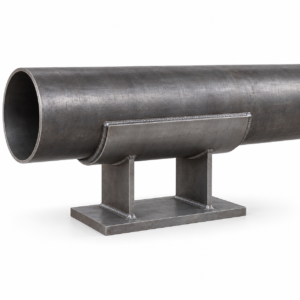
| Pipe roller support | Supports vertical load while allowing planned axial movement with reduced sliding resistance | Travel, alignment, stability, bearing reaction, and maintenance are design inputs; compare the adjustable steel pipe roller stand |
| Guide, anchor, or restraint | Controls one or more pipe-movement directions or transfers defined forces | Requires an engineered load path and cannot be inferred from the presence of a hanger |
Customization Note: The correct support depends on the piping stress model, movement direction, load combinations, insulation, structure, accessibility, and maintenance plan. This comparison describes functions and is not a universal substitution rule.
Load, Temperature, and Movement Require Project Review
Published catalog loads and temperature limits apply only to the stated supplier series, material, section, fasteners, finish, size, test basis, and installation conditions. They must not be transferred to a custom YOUNGLEE hanger merely because the overall shape looks similar. The project engineer should provide the governing sustained, operating, occasional, test, and applicable dynamic load cases, together with temperature and corrosion conditions.
Pipe movement also matters. A clevis hanger may permit limited rotation or swing needed for installation and normal response, but it is not a substitute for a roller, slide plate, constant support, variable spring, sway brace, or seismic restraint. Movement direction, magnitude, friction, adjacent support behavior, and nozzle loads should be resolved by the piping-support design.
Installation and Inspection Considerations
Before installation, verify the part number or drawing, pipe size, actual outside diameter, material, finish, rod and cross-bolt hardware, and any insulation shield or insert. Inspect formed straps for damage, cracks, sharp edges, coating defects, distorted holes, and shipping deformation. The structural attachment and hanger rod must be approved for the imposed load and installation method.
During assembly, support the pipe safely, install the lower strap and cross bolt in the intended orientation, retain all specified nuts and washers, and set the elevation using the approved adjustment procedure. The hanger should not be forced into alignment by bending the straps on site. Final inspection should confirm engagement, hardware retention, clearance, plumbness where required, contact condition, insulation integrity, and the absence of unintended restraint.
The featured image is a generated representative visual of an unbranded adjustable clevis hanger. It illustrates the general yoke, lower strap, cross-bolt, and threaded-rod geometry only. It does not prove a material grade, coating standard, dimensions, load rating, temperature limit, certification, or previous YOUNGLEE project supply.
Frequently Asked Questions
Is a clevis hanger the same as a U-bolt pipe clamp?
No. A clevis hanger suspends a pipe from above with a yoke and lower cradle. A U-bolt usually fastens or restrains a pipe against another support surface. Their load paths, clearances, hardware, and installation requirements differ.
Can the hanger be sized from NPS or DN alone?
No. Provide NPS or DN plus actual pipe outside diameter, coating, insulation thickness, shield or insert, manufacturing tolerance, and required clearance. Nominal size alone may not define the supported diameter.
Does Type 1 automatically mean MSS SP-58 compliant?
No. Type 1 identifies the product family. Compliance also depends on the specified edition, material, design, load rating, testing, manufacture, marking, documentation, selection, and installation requirements.
Can an adjustable clevis hanger support insulated pipe?
Yes, when it is combined with a properly designed shield, saddle, load-bearing insert, or other insulation-support detail. The ordinary lower strap should not crush insulation or compromise the vapor barrier.
What documents can be supplied?
Depending on the order, documentation may include material certificates, dimensional reports, coating records, fastener certificates, welding records when applicable, inspection results, load-test records when specified, packing lists, and drawing traceability. Required documents and acceptance criteria must be agreed before manufacture.
Request a Quote for Adjustable Clevis Pipe Hangers
Send YOUNGLEE the NPS or DN and actual pipe outside diameter, pipe material and coating, insulation thickness and support detail, hanger-rod diameter and thread, required adjustment and installation envelope, upper-yoke and lower-strap dimensions, cross-bolt and hardware specification, material grade, finish, quantity, operating and test loads, temperature, corrosion environment, movement requirements, structural attachment, inspection documents, drawing, and applicable standard with edition. For any inch dimension, preserve every decimal place supplied by the buyer: YOUNGLEE multiplies the unrounded inch value by 25.4 to convert it to millimetres. Custom clevis hangers are confirmed only after project technical review and approval of the manufacturing drawing.