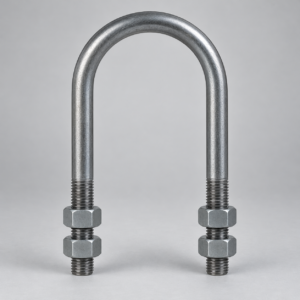

ASTM A320 L7 insulated U-bolts are drawing-controlled alloy-steel pipe fasteners for low-temperature projects that require a non-metallic barrier at the pipe contact area. SINO-ALLOY can manufacture each custom round-bend U-bolt, specified nuts and washers, protective coating, and PTFE or other project-approved sleeve as one coordinated assembly. The L7 designation governs bolting material requirements; it does not by itself define U-bolt geometry, coating, insulation, load capacity, or installed clearance. Grip and non-grip arrangements are available for fixed restraint or guided movement, subject to the piping-support design. Actual pipe outside diameter, rod diameter, inside width, leg length, thread details, operating temperature, corrosion environment, and inspection requirements must be confirmed before production.
ASTM A320 L7 Insulated U-Bolt at a Glance
| Item | Available basis | Selection note |
|---|---|---|
| Product type | Round-bend insulated U-bolt; grip or non-grip/guide assembly | The support drawing must state the required function. |
| U-bolt material | ASTM A320/A320M Grade L7 alloy-steel bolting material when specified | The purchase specification must identify the applicable standard edition, grade, size basis, tests, and documentation. |
| Geometry | Customer drawing or ASME B18.31.5 inch-series bent-bolt requirements where applicable | The material specification does not define the finished bend or pipe fit. |
| Contact isolation | PTFE sleeve or another project-approved polymer/elastomer system | Material, thickness, coverage, temperature, wear, and compatibility require review. |
| Surface protection | Project-specified coating system for exposed alloy steel and compatible hardware | Coating family, pretreatment, film build, cure, colour, thread allowance, and inspection must be stated. |
| Typical use | Low-temperature process piping, terminals, gas-processing facilities, cold-service utility lines, and engineered supports | Suitability depends on the complete support design and service conditions. |
| Supply format | U-bolt with specified nuts, washers, sleeve, and optional support components | Bill of materials and traceability scope are defined by the order. |
Customization Note: These entries describe available configuration choices, not a universal stock range or a guaranteed design rating. SINO-ALLOY finalizes each assembly against the governing standard, approved drawing, actual pipe outside diameter, insulation build-up, installation geometry, load case, temperature, corrosion exposure, and inspection plan.
What ASTM A320 Grade L7 Defines—and What It Does Not
ASTM A320/A320M covers alloy-steel and stainless-steel bolting materials for low-temperature service. For an L7 procurement, the standard controls material-related requirements such as chemistry, heat treatment, mechanical properties, hardness, and impact-energy verification under the applicable order. These requirements are meaningful because low-temperature selection is not established by a dark coating or by the shape of a finished U-bolt.
ASTM A320/A320M does not turn a bent rod into a complete pipe-support design. The bend radius, inside width, leg length, thread length, fit over the pipe, nut position, sleeve thickness, guide clearance, and support reaction must come from the bent-bolt standard and project drawing. ASME B18.31.5 provides general and dimensional requirements for several inch-series bent-bolt forms, including U-bolts, while also recognizing that non-tabulated configurations can be ordered by explicitly identifying dimensions, material, and finish.
| Specification layer | What it should control | What the buyer should state |
|---|---|---|
| Bolting material | Grade L7 material and required verification under ASTM A320/A320M | Edition, inch-pound or SI designation, grade, diameter, test and certificate requirements |
| Bent-bolt geometry | Round bend, rod diameter, inside width, leg length, thread length, bend radius, and tolerances | ASME B18.31.5 form where applicable or a fully dimensioned approved drawing |
| Nuts and washers | Grade, dimensions, proof-load requirements, quantity, position, and finish compatibility | Exact nut/washer standards and grades; substitutions only with written approval |
| Isolation system | Contact barrier, sleeve coverage, thickness, joints, washers, and optional backing pad | Material specification, design temperature, electrical or corrosion-isolation purpose, and wear criteria |
| Protective coating | Corrosion protection for exposed steel and threaded components | Named coating system, pretreatment, film build, cure, colour, test method, and acceptance criteria |
| Support engineering | Grip or guide function, load path, movement, installation, and inspection | Pipe reactions, allowable movement, tightening method, support steel details, and project design basis |
Customization Note: Standards have separate responsibilities. A compliant L7 material certificate cannot confirm the finished U-bolt dimensions, and a dimensionally correct U-bolt cannot confirm low-temperature material compliance without the specified documentation and test basis.
Why Choose L7 Instead of B8M?
The choice is an engineering decision, not a simple ranking. Grade L7 is an alloy-steel bolting material selected when the project requires the applicable low-temperature bolting specification. Grade B8M is an austenitic stainless-steel grade within ASTM A320/A320M and is often considered when corrosion exposure, stainless metallurgy, and the specified class are central to the design. SINO-ALLOY’s ASTM A320 B8M Class 2 insulated U-bolt page explains that separate stainless configuration.
| Selection factor | ASTM A320 L7 assembly | ASTM A320 B8M assembly |
|---|---|---|
| Base-material family | Heat-treated alloy steel | Austenitic stainless steel |
| Primary procurement distinction | Specified low-temperature alloy-steel bolting requirements | Specified stainless grade/class plus project corrosion and mechanical requirements |
| Corrosion strategy | Usually requires a separately defined protective coating system for the exposure | Stainless selection helps address some environments, but grade/class and coating still require review |
| Identification | Material records and order requirements; appearance is not proof | Material records and order requirements; appearance is not proof |
| Interchangeability | Do not substitute one grade for the other without engineering and purchaser approval. | |
How the Insulation System Changes the Finished Fit
A sleeve is part of the dimensional stack, not a decorative add-on. The finished inside width must account for the actual pipe outside diameter, sleeve thickness, any backing pad or isolating washer, coating thickness, installation clearance, and the required grip or guide behavior. Specifying NPS or DN alone is insufficient because nominal pipe size is not the same as actual outside diameter.
PTFE sleeves are used in industry where a low-friction, chemically resistant contact barrier is desired, but the exact grade, fabrication method, temperature range, creep behavior, wear allowance, and interface pressure are project-specific. Rubber or other polymer sleeves may serve different isolation or cushioning needs. The broader insulated U-bolt configuration overview shows common construction families; this L7 page is specifically about the low-temperature alloy-steel bolting option and its documentation boundary.
Grip or Non-Grip: What Function Is Required?
A grip U-bolt is intended to hold the pipe in a defined restrained arrangement. A non-grip U-bolt, also called a guide U-bolt in many specifications, uses controlled clearance so that the pipe can move axially while lateral displacement is limited. Neither function should be inferred from the product name or nut count.
| Design question | Grip arrangement | Non-grip / guide arrangement |
|---|---|---|
| Pipe contact | Defined clamping contact according to the support design | Designed clearance remains around the pipe or sleeve |
| Axial movement | Restricted only as calculated and detailed | Permitted within the guide design and adjacent restraint system |
| Nut location | Set by the clamping and locking detail | Often controlled with nuts around the support member, but the drawing governs |
| Critical input | Allowable contact pressure, tightening method, and pipe wall sensitivity | Cold and operating clearances, movement direction, wear surfaces, and support spacing |
No universal torque or safe working load is stated here. U-bolt stresses, thread engagement, bend effects, pipe-wall contact, support-member stiffness, vibration, fatigue, thermal movement, and installation practice all affect the assembly. The piping/support engineer must approve the design load and tightening procedure.
Manufacturing and Inspection Plan
SINO-ALLOY can manufacture ASTM A320 L7 U-bolts to an approved standard designation or customer drawing. The order should define whether material processing, bending sequence, heat treatment, mechanical testing, impact testing, hardness, marking, dimensional inspection, coating inspection, and traceability apply to raw material, finished components, or the complete assembly. This avoids an ambiguous statement that a coating or assembled support “meets ASTM A320” when the standard is principally a bolting-material specification.
Threads, coating allowance, nut fit, sleeve ends, and bend symmetry should be checked together before packing. If an insulation system covers part of the U-bolt, the inspection plan should identify which surfaces remain visible and how identification is preserved. Any project-specific test, certificate, or inspection witness point must appear in the inquiry and purchase order; it is not automatically included.
Information Required for a Reliable Quotation
- Actual pipe outside diameter and, where useful, the related NPS or DN.
- Rod diameter, inside width, inside height, leg length, thread length, bend radius, and dimensional tolerances.
- ASTM A320/A320M edition, Grade L7 requirement, inch-pound or SI basis, and material-documentation scope.
- Thread form, pitch, nut and washer standards, grades, quantity, and locking arrangement.
- Grip, non-grip, or guide function plus cold and operating clearances.
- Sleeve or lining material, thickness, coverage, joint detail, backing pad, and isolating washers.
- Coating specification, pretreatment, film build, cure requirements, colour, thread allowance, and acceptance tests.
- Minimum and maximum operating temperature, corrosion environment, pipe metallurgy, and galvanic-isolation requirement.
- Design loads and directions, thermal movement, vibration/fatigue conditions, support-member details, and installation method.
- Quantity, inspection plan, marking, traceability, certification, packing, and drawing-revision requirements.
Frequently Asked Questions
Does ASTM A320 L7 define the U-bolt dimensions?
No. It defines bolting-material requirements for low-temperature service. The finished U-bolt geometry must come from an applicable bent-bolt standard such as ASME B18.31.5 or from an approved project drawing.
Can NPS or DN be used as the only sizing input?
No. The actual pipe outside diameter is required, and the fit must also include sleeve, coating, pad, and functional clearance. Nominal size alone can produce an incorrect inside width.
Is a PTFE-sleeved U-bolt automatically a pipe guide?
No. PTFE identifies an isolation/contact material, while guide behavior depends on deliberately specified clearance and the surrounding restraint layout. A PTFE-sleeved assembly can be designed as grip or non-grip.
Is ASTM A194 Grade 7 hardware automatically included?
Not automatically. Nut standard, grade, size, proof-load requirement, coating, and low-temperature project requirements must be stated in the purchase specification. Substitution should not be assumed.
Can SINO-ALLOY state a universal load or minimum service temperature?
No universal assembly value is appropriate without the complete design. Material test requirements, finished geometry, thread engagement, sleeve properties, pipe contact, installation, load direction, temperature, and support steel all affect suitability.
Request a Project-Specific Quote
Send SINO-ALLOY the approved support drawing and bill of materials, actual pipe outside diameter, Grade L7 and standard-edition requirement, U-bolt and thread dimensions, nuts and washers, insulation system, coating, grip or guide function, operating temperature, corrosion environment, loads, quantity, and inspection documentation. SINO-ALLOY will review production to the applicable standard or drawing and confirm the custom dimensions, material route, surface protection, insulation components, inspection scope, and packing basis for your project.